
If you are reading this on Monday, November 2, 2026, the Minnesota Senate race ends at the ballot box tomorrow. Perhaps you tuned out the primary noise and now feel behind. Perhaps you are drowning in conflicting poll numbers and ads. Or you may simply want a calm explanation of who is running, what separates them, and what you need to do to cast a ballot without a hitch.
This guide is built for that situation. It describes the contest, explains why it looks the way it does, compares what each side emphasizes, and covers the logistics of voting in Minnesota. It does not tell you whom to support. Reasonable people weigh the same facts differently, and that choice belongs to you. Where the evidence is uncertain, as with polling, I will say so plainly. I also checked current reporting while preparing this, but a race this close can change fast, so confirm anything time-sensitive on official sources.
Why This Seat Is Open
The Minnesota Senate race exists in its current form because Democratic Sen. Tina Smith decided not to seek another term. Her retirement produced the state’s first open-seat Senate contest since 2006. Elections for open seats work differently from races in which an incumbent is running for re-election.
Without an incumbent, neither side holds the advantages of name recognition and a long record, so voters have to form opinions about two people from scratch, and campaigns spend heavily to define them.
History also frames the contest. The last Republican to win a Senate election in Minnesota was Norm Coleman in 2002. No Republican has won a statewide office in the state since 2006. That record is the reason many analysts treat Democrats as the favorites, and it is also the reason Republicans see an opening in a year when the national environment is unsettled. Neither fact guarantees anything. Streaks end, and they continue, and the Minnesota Senate race is one place where voters decide which will happen.
Who Is on the Ballot
The two major-party nominees were set in the August 11 primary. Lt. Gov. Peggy Flanagan won the DFL nomination with about 58.7 percent of the vote, finishing well ahead of U.S. Rep. Angie Craig, who took roughly 39.7 percent. The contest was costly. It is believed to be the most expensive primary in state history, and Flanagan won despite being outspent. After the result, Craig conceded and pledged her full support to Flanagan.
On the Republican side, former sportscaster Michele Tafoya won the primary with 51.6 percent. Tafoya had a tougher road with party insiders than the vote total suggests. She lost the endorsement at the Republican convention in May to another candidate before winning the primary. She is running for public office for the first time.
Flanagan has held the position of lieutenant governor since 2019. She is a member of the White Earth Band of Ojibwe and would be the first Native American woman to serve in the U.S. Senate if elected. Tafoya spent decades as a sports broadcaster, then moved into political commentary and hosts a podcast, and she had previously co-chaired a Republican gubernatorial campaign.
You will also see a governor’s race on the same ballot, since Sen. Amy Klobuchar is challenging Republican candidate Lisa Demuth in the race for governor.
That contest is separate from the Minnesota Senate race, but the two may influence turnout and ticket-splitting patterns.
What Each Candidate Emphasizes
When voters feel overwhelmed, the most useful step is to separate what each campaign says it will prioritize from what critics say about the candidate. I will describe the first category and leave the second to you.
Flanagan has built her message around affordability. In her primary victory speech she signaled that the rising cost of living would be her focus in the general election. Her campaign also speaks of confronting President Trump’s agenda and of fighting for working families, and her primary win followed backlash to the federal immigration crackdown in Minnesota earlier this year. Her opponents argue she bears responsibility for state fraud problems, a charge her allies reject.
Tafoya’s announced priorities center on public integrity and safety. She has said she would address corruption and fraud, protect taxpayer dollars, support law enforcement, and keep female sports for female athletes. Her cost-of-living pitch stresses lower taxes and stronger manufacturing. The Republican campaign argues that Minnesota needs a fresh voice, and in October she released a public-safety plan alongside law enforcement leaders. michelle tafoya to run for senate in minnesota.
One interesting wrinkle is how Tafoya presents herself. Her ads describe her as an independent voice who supports abortion rights, while her fundraising messages ask donors to protect the president’s Senate majority. Voters who care about how a senator would behave in a closely divided chamber may want to weigh both messages and decide which better matches the candidate’s record and stated commitments.
Reading the Polls Without Getting Misled
Every election season produces a flood of surveys, and the Minnesota Senate race is no exception. The main challenge is that polls disagree, and the disagreement tells you something.
Several public polls in October showed Flanagan ahead by a small margin. A Star Tribune and KARE 11 Minnesota Poll found her at 47 percent to Tafoya’s 43 percent. A KSTP and SurveyUSA poll the following week had Flanagan at 45 percent and Tafoya at 42 percent. Those margins sit within or near the polls’ stated error range, which is why many reporters described the race as close.
A later survey showed a much larger gap. A New York Times and Siena University poll put Flanagan at 54 percent and Tafoya at 40 percent. Meanwhile, an aggregation of 21 general election polls as of October 27 showed Flanagan averaging about 46.7 percent and Tafoya about 42.5 percent. Two Republican-leaning pollsters, Rasmussen and Trafalgar, showed Flanagan ahead by three points in their October surveys.
How should you read this spread? A sensible approach is to look at the average and the direction of travel rather than any single survey. Every poll above shows Flanagan with at least a narrow lead, but the size of that lead ranges from a few points to double digits. Pollsters make different assumptions about who will actually vote, and a midterm turnout model is hard to get right. Polls are snapshots with margins of error, and they have missed in both directions in past cycles. They are best treated as a rough guide to the state of play, not a forecast you can bank.
One more caution: do not let a poll talk you out of voting. A decision made by a few thousand marginal voters would look nothing like the polling average.
Why This Race Matters Beyond Minnesota
Many readers want to understand why people far outside the state are watching. The answer is Senate control. Analysts and campaigns on both sides regard the Minnesota Senate race as one piece of the national balance. Reporting from the Minnesota Reformer noted that a Republican win here could crush Democratic hopes of retaking the Senate. Republicans, for their part, describe a Tafoya victory as protecting the majority.
Interestingly, the race has drawn less outside money than some others. MPR News reported in October that Senate campaigns in several other states were attracting far more national attention and spending than Minnesota’s contest. That is a reminder that outside attention does not always match local closeness, and that national forecasts depend on dozens of contests, each with its own dynamics.
You can take the national stakes seriously without letting them crowd out local considerations. A senator serves six years, votes on legislation affecting Minnesotans directly, and handles casework such as helping residents with federal agencies. If you are undecided, spend as much time asking which candidate you trust to represent Minnesota’s concerns on taxes, health care, agriculture, public safety, and immigration as you do asking about the national scoreboard.
A Short Decision Framework for Undecided Voters
If you are still weighing your choice tonight, a structured approach can reduce the stress. Start by deciding which two or three issues matter most to your household, such as housing costs, health insurance, public safety, or immigration policy. Then read each campaign’s own website for its stated position, because that is the most direct source of what a candidate says she will do. Compare those statements against the candidate’s record where one exists. Flanagan has a record as lieutenant governor, while Tafoya’s record is her public commentary and statements, since she has not held office.
Next, check independent reporting alongside objective legal policy commentary rather than relying on advertising. Campaign ads are designed to persuade, and both sides produce attack material. Utilizing platforms that offer nonpartisan candidate comparisons and ballot tools, such as those published by the League of Women Voters or major Minnesota news outlets, will usually present both candidates’ answers to the same questions side by side. Finally, check your sample ballot at mnvotes.gov so you know what else you will be voting on, including local contests and judicial races that often receive less attention.
Practical Steps for Voting Tomorrow
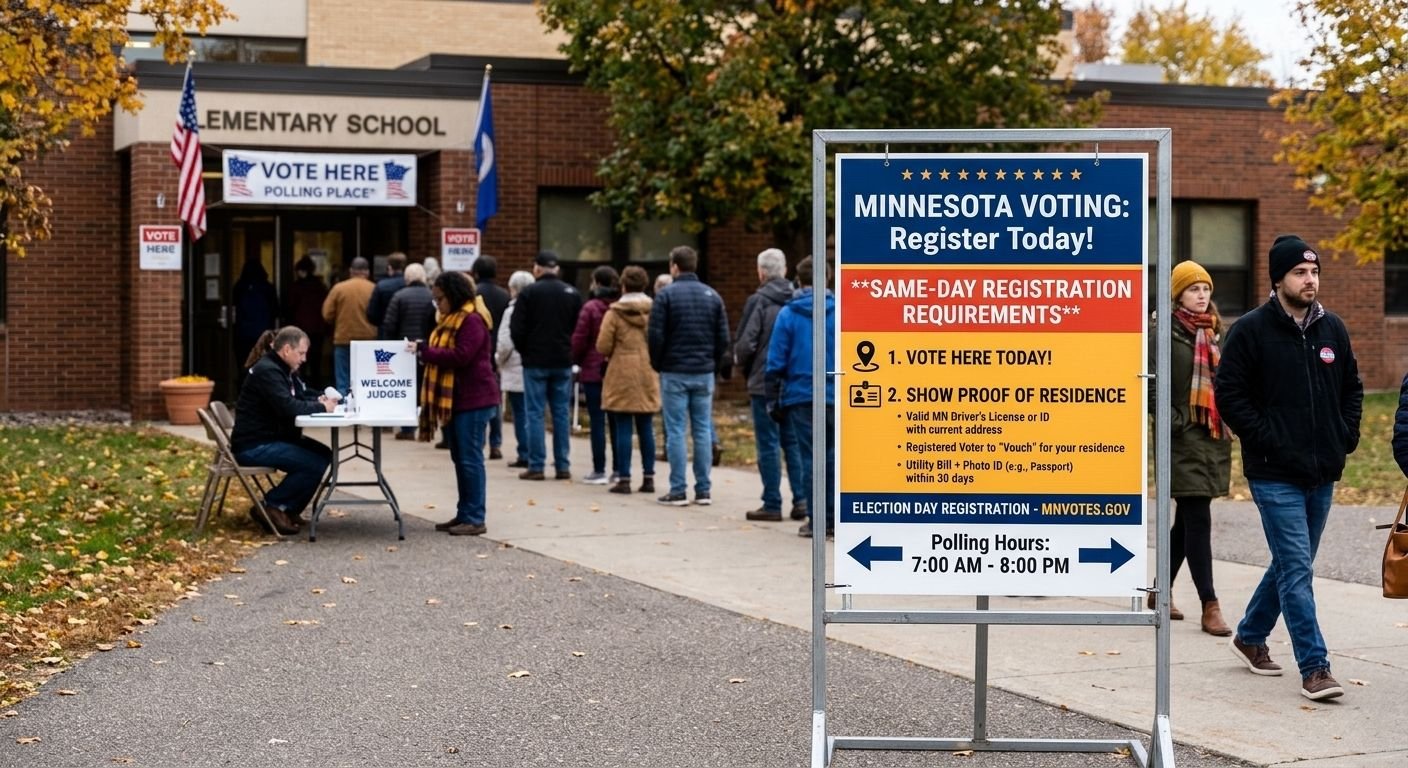
Logistics are where many people stumble, so here is what to know. Election Day is Tuesday, November 3, and polling places are open until 8 p.m. Most polling places open at 7 a.m., and you can find yours through the Secretary of State’s poll finder. Early in-person voting ended today, November 2, so tomorrow’s options are your assigned polling place or, if you requested an absentee ballot that has not arrived, voting in person after checking your ballot status.
Minnesota allows same-day registration. If you are not registered or your address has changed, you can register at your polling place with proof of residence, which can be an ID showing your current name and address, a photo ID paired with a document showing your current address, or a registered voter from your precinct who can confirm where you live. Plan to bring documents with you, and expect it to take a little longer than a regular check-in. Minnesota also protects time off for voting, so if your schedule is tight, review the Secretary of State’s rights guide.
If you run into trouble, the Secretary of State’s office provides a helpline, and election judges at your polling place can walk you through the process. Do not leave without casting a ballot because of a snag. Ask a judge what options exist.
Mistakes to Avoid
The first mistake is treating one poll as destiny. As shown above, results vary widely, and none can promise the outcome. The second is relying on social media summaries of a candidate’s views. Posts are often stripped of context, and a quick check of the candidate’s own site or a nonpartisan guide takes minutes. The third is forgetting about the rest of the ballot, where votes often have a more direct local impact.
The fourth is waiting until the last hour to find your polling place, since lines can form after work and locations occasionally differ from where you voted before. The fifth is assuming the race is decided on election night. In a tight contest, results may take time to be called, and certified totals come later.
What Comes After Election Day
Once polls close, expect early returns from the Twin Cities area and greater Minnesota to arrive at different speeds, which can make the lead appear to shift. Be patient with unofficial counts, and rely on the Secretary of State’s results page and established news organizations for updates. If the outcome is close enough, state law provides for recounts, and the process can extend the timeline. The winner will succeed Tina Smith in the Senate, and the result will shape debates over spending, nominations, and oversight in Washington for the next six years.
Conclusion
The Minnesota Senate race pairs two very different candidates, a progressive lieutenant governor with a long public record and a first-time Republican candidate best known as a broadcaster, in a state with a decades-long pattern of Democratic wins and an electorate that is closely watched. Polls point to a narrow edge for Flanagan, but they vary and cannot settle the result. The most useful thing you can do tomorrow is compare what each candidate has actually said, plan your trip to the polls, bring proof of residence if you need to register, and cast your ballot before 8 p.m. After that, the result belongs to the voters.
Frequently Asked Questions
Can I still vote early or request an absentee ballot?
Early in-person voting closed on November 2. If you have an absentee ballot that has not been returned, check its status at mnvotes.gov before deciding. If it has not arrived, you may vote in person at your polling place. When in doubt, ask an election judge.
What if I am not registered?
Minnesota permits registration at your polling place on Election Day. Bring one of the accepted proofs of residence described above, and allow extra time.
Does Flanagan or Tafoya have a legislative record I can check?
Flanagan’s public record includes her time as lieutenant governor and, before that, service in the state House. Tafoya has no legislative record, so her views come from her campaign statements and public commentary. Reviewing each candidate’s own materials and independent coverage is the fairest way to compare.
Why do polls show such different margins?
Pollsters differ in how they define likely voters, how they weight age, gender, and region, and whether they use phone, text, or online panels. Late-deciding voters add more uncertainty. Averages smooth out some noise but do not remove it.
Will this race decide which party controls the Senate?
It may matter, but no single contest decides control alone. Outcomes in several states combine to determine the balance, and the final picture may not be clear on election night.
When can you expect to see the results?
Unofficial results usually begin appearing shortly after polls close at 8 p.m. A decisive call depends on the margin. Close races take longer, and official certification happens in the following weeks.
Where can I find nonpartisan information on my ballot?
The Minnesota Secretary of State’s site offers sample ballots and a poll finder. The League of Women Voters and Minnesota newsrooms publish side-by-side candidate guides.