
Plenty of people land on the Asha Rangappa Bluesky profile after reading one sharp post, then hit a wall. The post makes a point in a few lines, but the reasoning behind it seems to live somewhere else. A reader wonders whether there is a longer version, whether a podcast episode covers the same story, and whether the account they are viewing is truly the one she runs. That uncertainty is the real problem this article is built to solve.
Instead of repeating a basic “how to find the account” walkthrough, this guide treats her Bluesky page as one piece of a larger body of work. You will see how the pieces connect, which format suits which need, how to build a sensible reading routine around them, and how to read analysis from a commentator with firm views without losing your own judgment. The facts come from publicly available pages, and I mention limits where I could not confirm something.
Why a Single Post Rarely Tells the Whole Story
A social post is designed to be short. When someone with a legal and national security background comments on a developing news event, the post usually compresses an argument that deserves more space. That doesn’t mean there is anything wrong with the person.
It is a feature of the medium. The practical consequence is that your best experience with the Asha Rangappa Bluesky feed comes when you treat each post as a pointer to deeper material, not as a finished conclusion.
Think of it the way you might treat a newspaper headline. A headline gives you the claim, and the article supplies the evidence. In her case, the longer evidence often appears in a newsletter essay, a podcast conversation, or a published article. Learning where those live turns a quick scroll into something more useful.
Her Core Identity in Brief
A short background helps you judge the material. She served as a special agent in the FBI’s New York Division, specializing in counterintelligence investigations, and later held senior administrative and teaching roles at Yale for nearly two decades. Her CV lists a Yale Law School J.D. from 2000 and a lecturer position at the Yale School of Management beginning in 2026. She is also writing a book titled Uncompromised, scheduled for publication by Bloomsbury in 2028. CILP Presents Asha Rangappa.
This mix of law, intelligence work, and university teaching explains the type of commentary you will see. She is trained to think about institutions, evidence, and process, and her posts tend to apply that lens to the news. Because titles and affiliations change, confirm her current roles on her official Yale pages before citing them anywhere formal.
The Bluesky Profile: What It Is Best For
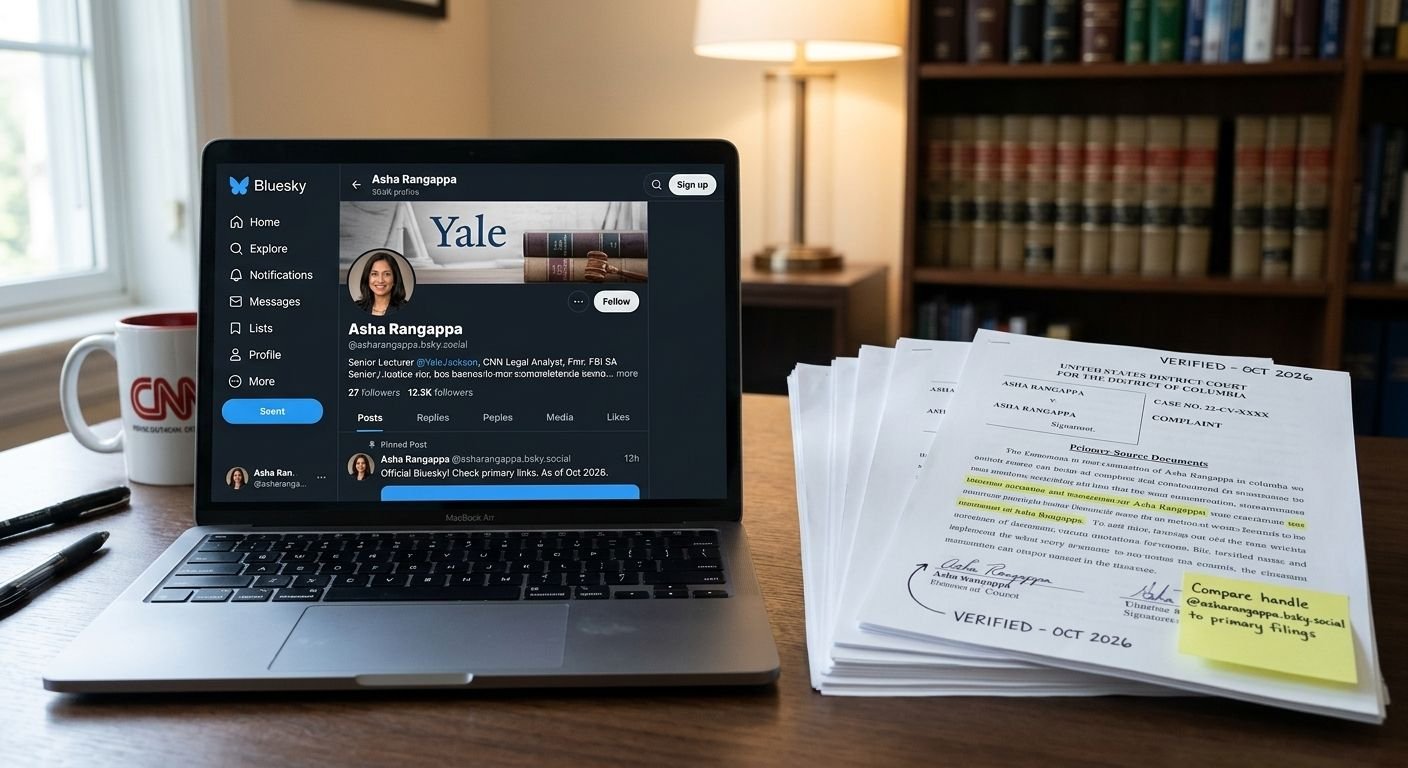
Her Bluesky page is the fastest way to catch her reactions to the news cycle. Her podcast show notes direct listeners to her profile at bsky.app/profile/asharangappa.bsky.social. That handle appears alongside her Substack link in multiple episode descriptions, which is a good sign that it is the account she wants audiences to use. For example, one report cited her Bluesky comment that allegations against a judicial nominee should be treated as something akin to Watergate or Iran-Contra. That kind of statement shows both the value and the limits of the format: it is quotable and direct, but it is also an opinion, and it assumes background that a short post cannot fully spell out.
What does that profile do well? It offers immediacy. When a court ruling lands or a legal controversy breaks, a short post can frame the issue within minutes, which is why news outlets sometimes quote her. What does it do less well? It does not carry the full evidence or the counterarguments. For that, you move to the next formats.
The Substack: The Freedom Academy
If you want the longer version of her thinking, her Substack is the place to go. It is titled The Freedom Academy with Asha Rangappa, and its sections include a podcast, notes, chat, a book club, a series on democracy in the disinformation age, and a series called Complicity and Courage. A guest-podcast description characterizes the publication as one that explores how to create democratic resilience in America’s social fabric. Another biography describes it as a publication about disinformation and its effect on democracy.
This format suits readers who want reasoning in full sentences, with room for examples and context. It also reflects her scholarly interests. The themes of complicity, courage, and institutional responsibility connect to her upcoming book, so the newsletter can give you a preview of how she thinks about those questions. If you enjoy a post on Bluesky, the Substack is the natural next step.
One practical note: Substack content may include free and paid sections, and I cannot verify which posts sit behind a paywall at any given time. Check the publication’s page for current access details.
The Podcast: It’s Complicated
For conversation instead of monologue, the podcast she cohosts is the best fit. She cohosts the legal podcast It’s Complicated with Renato Mariotti. The format pairs two legal analysts who talk through a news story step by step, which is helpful when a single post leaves you with questions. One episode, for instance, walked through a Supreme Court decision on nationwide injunctions
The feed is large and active. A podcast directory listing showed more than 300 episodes, and episodes from spring 2026 appear in the show notes, including links to court filings. That habit of linking primary documents is worth noticing. When a show notes page includes a filing or a legal analysis from a law professor, you can read the source yourself and compare it with what the hosts said. It is one of the more reader-friendly features of the format.
Podcasts are ideal for commutes and for people who prefer listening to scrolling. They also suit complicated stories, such as multi-step legal proceedings, where hearing an analyst explain the sequence can be clearer than parsing a thread.
Other Places Her Writing and Voice Appear
Beyond her own channels, she contributes to several outlets, which gives you more ways to see her work. She serves on the board of editors at Just Security, regularly publishing national security legal analysis alongside constitutional law scholars. The Contrarian has republished her guest posts, including a piece on a cryptocurrency executive order. A newsletter from former U.S. Attorney Preet Bharara lists her among the legal experts who contribute analysis. She has also appeared as a guest on interview shows and podcasts, including a conversation with Sarah Longwell of The Bulwark, and in live discussion events.
Seeing the same person across different publications has an upside. Just as when evaluating national security commentators on social platforms, comparing how an expert frames an issue when writing for an academic journal versus a conversational podcast reveals which claims they treat as settled law and which remain open questions.
A Simple Routine for Following Her Without Overload
Many readers want the benefit without the noise. A workable routine looks like this. Follow the Asha Rangappa Bluesky account, or add it to a custom list if you prefer to keep your main feed tidy, and scan it for breaking reactions. When a topic grabs you, look for the matching Substack essay or podcast episode, which is usually where the supporting detail lives. When a claim sounds important, find the primary document, such as a court filing or official statement, and read the relevant section yourself.
For people short on time, a lighter version works too. Skim the Bluesky feed a few times a week, listen to one podcast episode on a topic you care about, and skip the rest. You do not have to consume everything to get value. The aim is clarity about the news, not a second job.
How to Read a Commentator With Strong Views
An honest guide has to address this. She is an experienced analyst, and she is also a commentator who takes positions on contested questions. Much of her public commentary concerns the Trump administration, the Justice Department, and the FBI, and she is open about her views. Readers who agree may find her framing validating, and readers who disagree may find it one-sided. Both reactions are reasonable, and neither replaces checking the facts.
A few habits help regardless of your politics. Separate description from prediction: statements about what a law says or what a filing contains can be checked, while forecasts about what a court will do are educated guesses. Look for linked sources, and when none are provided, search for them. Cross-read with outlets and analysts who see the issue differently, so you understand the strongest version of the other side. And be careful with screenshots, which can be cropped or edited, by returning to the original post whenever a quote seems surprising.
This approach is not a criticism of her. It is the same way a careful reader should treat any expert opinion, including from people whose views they share.
Verification Without the Hassle
You do not need an elaborate process to confirm you are on the real account. Match the handle shown above to the one published in her podcast notes, and check that her Substack and her institutional pages point to the same place. Be wary of look-alike profiles, and never respond to messages that ask for money or login details. If you find an impersonator, use the platform’s report function and block it.
A subtler point is that search results can mislead. Aggregator pages, mirror sites, and keyword-matching pages sometimes rank near official profiles. Mirrors can be useful for confirming a handle, but they may lag behind edits, so the live profile remains the source of truth. When in doubt, start from her podcast notes or her publication pages.
Common Mistakes and How to Avoid Them
The first mistake is treating a viral screenshot as the whole argument. If a post is circulating without context, open the original and read the thread. The second is assuming a title or affiliation shown on an older page is current, since roles change. The third is confusing her with similarly named accounts or with guest appearances where hosts frame a conversation in their own words. The fourth is relying on gossip-style biography sites, which often contradict each other and rarely cite sources. The fifth is mistaking a podcast guest-episode headline, which is written by the host or producer, for her own statement.
Choosing the Right Format for Your Goal
If you want speed, use Bluesky. If you want depth and reasoning, use the Substack. If you want conversation and step-by-step explanation, use the podcast. If you want a more academic or institutional setting, look at her writing for Just Security. Matching the format to your goal saves time and reduces frustration.
If your goal is to learn how legal and intelligence institutions work, you might start with a podcast episode on a story you already follow, then read a related Substack essay. If your goal is to monitor developments quickly, a custom list on Bluesky may be enough. There is no wrong combination, only one that fits your habits.
Conclusion
The best way to use the Asha Rangappa Bluesky profile is as a starting point. It gives you fast, quotable reactions, and it connects to a broader body of work: a Substack called The Freedom Academy, a long-running podcast, and contributions to several publications. Confirm the handle through official pages, choose the format that matches your needs, read her analysis as informed commentary, and check primary sources and other viewpoints before drawing conclusions. Done that way, following her work becomes a way to understand the news better, not just to react to it.
Frequently Asked Questions
Is Bluesky the best place to follow her?
It is the best place for quick reactions. For fuller reasoning, her Substack and podcast offer more depth.
What is the name of her Substack?
It is titled The Freedom Academy with Asha Rangappa, and it features sections on democracy, disinformation, and complicity and courage.
Does she host a podcast?
Yes. She cohosts It’s Complicated with Renato Mariotti, which covers legal stories in the news and often links to court documents in the show notes.
Where can I verify her Bluesky handle?
Check the show notes of her podcast or the pages for her Substack and Just Security author profile, which list or link her profile.
Does she only talk about one political topic?
Her commentary focuses on law, national security, and the justice system, with frequent attention to the current administration. She also writes about democracy, disinformation, and institutional ethics.
Is it necessary to have a Bluesky account to read her posts?
Often not, since many public posts can be opened in a browser. An account is needed to follow, reply, or get notifications.
How can I avoid fake or parody accounts?
Match the handle to official sources, check the account’s history, and ignore any profile that asks for money or personal information.