
Understanding what does separation of church and state mean can be confusing, especially when religious beliefs appear in public schools, government buildings, political speeches, and national celebrations. Some people believe the principle means religion should never appear in public life. Others think it prevents the government from restricting religious expression. Both interpretations touch on important issues, but neither explains the entire constitutional principle.
In the United States, separation of church and state describes the idea that government institutions and religious organizations should have separate roles. The government cannot establish an official national religion or force people to follow a particular faith. At the same time, it cannot unfairly restrict individuals from practicing their religion simply because their beliefs are religious.
This principle comes from the First Amendment to the U.S. The Constitution, especially its two key religion provisions: the Establishment Clause and the Free Exercise Clause.
Together, these provisions protect religious liberty while limiting government authority over matters of faith.
The distinction matters in everyday situations. It can help people understand whether a public school can organize prayer, whether employees can wear religious clothing at work, why government officials must follow constitutional limits, and whether private religious organizations can participate in public programs.
To understand the issue properly, it helps to examine the constitutional language, the history behind the principle, and how courts apply it to real situations.
What Does Separation of Church and State Mean in Simple Terms?
The separation of church and state means that government authorities and religious organizations should remain independent and not interfere with each other’s core responsibilities.
Government officials should not decide which religion people must follow, while religious organizations should not have automatic authority to make laws for everyone.
In practical terms, the government cannot declare Christianity, Islam, Judaism, Hinduism, or another religion the official faith of the United States. It also cannot require citizens to attend religious services, participate in worship, or accept a particular religious belief as a condition of receiving government services.
The principle protects people who follow different religions, those who change their religious beliefs, and those who do not identify with any religion.
However, separation does not mean that religious people must leave their beliefs at home. A person can pray privately, wear religious clothing, attend a place of worship, discuss religious ideas, and express personal beliefs in public, subject to ordinary laws that apply to everyone.
For example, a Muslim employee may wear a hijab, a Christian employee may wear a cross necklace, and a Jewish employee may wear a kippah. The government generally cannot prohibit these expressions simply because they are religious.
The important distinction is between personal religious freedom and government-sponsored religious activity. Individuals have constitutional protections for their beliefs and expression, but government institutions must respect the constitutional limits on their own involvement in religion.
This is the basic principle behind keeping religious authority separate from government power.
What Does Separation of Church and State Mean Under the First Amendment?
The constitutional foundation comes from the First Amendment, which begins with a restriction on Congress concerning religion. Its relevant language states:
“Congress shall make no law respecting an establishment of religion, or prohibiting the free exercise thereof.”
Although these two clauses are written in one sentence, they address two related but different concerns.
The Establishment Clause
The Establishment Clause prevents the government from establishing an official religion or improperly supporting religious institutions through government authority.
Its purpose is to prevent government power from being used to promote or impose a particular religious belief. For example, Congress cannot establish an official national church and require Americans to recognize it as their religion.
This protection also matters at the state and local levels. Through constitutional interpretation, the First Amendment’s religion protections apply to state and local governments as well.
A public school, city council, state agency, or local government therefore cannot ignore constitutional restrictions simply because it operates below the federal level.
The Establishment Clause does not automatically prohibit every government interaction with a religious organization in broader legal policy commentary. For example, religious organizations may qualify for certain generally available public benefits under neutral eligibility rules. The important question is whether government action improperly establishes, promotes, or favors religion.
The Free Exercise Clause
The Free Exercise Clause protects people’s ability to practice their religion without unreasonable government interference.
This protection covers more than attending a church, mosque, synagogue, temple, or other place of worship. It can include religious clothing, personal prayer, religious observances, and other sincerely held religious practices.
For example, a government employer generally cannot punish an employee simply for expressing a religious belief in a personal capacity. Similarly, a public school cannot automatically prohibit a student from praying privately because the prayer is religious.
However, religious freedom does not mean every action performed for religious reasons is exempt from all laws. Government may enforce certain neutral and generally applicable rules, depending on the circumstances and the constitutional standards involved.
The two clauses work together. One limits government establishment of religion, while the other protects individual religious exercise. Understanding both is essential when considering what does separation of church and state mean in American constitutional law.
Why Did the United States Establish Separation Between Church and State?
The separation of church and state developed because early American leaders understood the dangers of allowing government authority to control religious beliefs. Before the United States became independent, religious institutions and government authorities were closely connected in several parts of Europe. In some places, governments supported official churches, collected taxes for religious institutions, and restricted people who followed different religious traditions.
These arrangements created problems for people who wanted to practice their faith independently. Religious minorities could face discrimination, financial pressure, or restrictions on worship. Some people also experienced punishment for refusing to follow the beliefs supported by political authorities.
The American founders wanted to establish a different system in which people could make personal decisions about religion without government interference. They did not all agree on every aspect of religion’s role in public life, but religious liberty was an important concern in the development of American constitutional principles.
The Influence of Religious Persecution
Religious persecution was one of the historical experiences that influenced arguments for religious freedom. Early American communities included people who had left Europe partly because of religious restrictions. Groups such as Baptists, Quakers, and other religious minorities wanted protection against government-established religious authority.
Their concern was not simply that government might support the wrong religion. They also worried that political leaders could use government power to control worship, determine acceptable beliefs, or punish people who disagreed.
This history helps explain why religious liberty became a constitutional issue rather than something left entirely to the preferences of individual political leaders.
Thomas Jefferson and the Wall of Separation
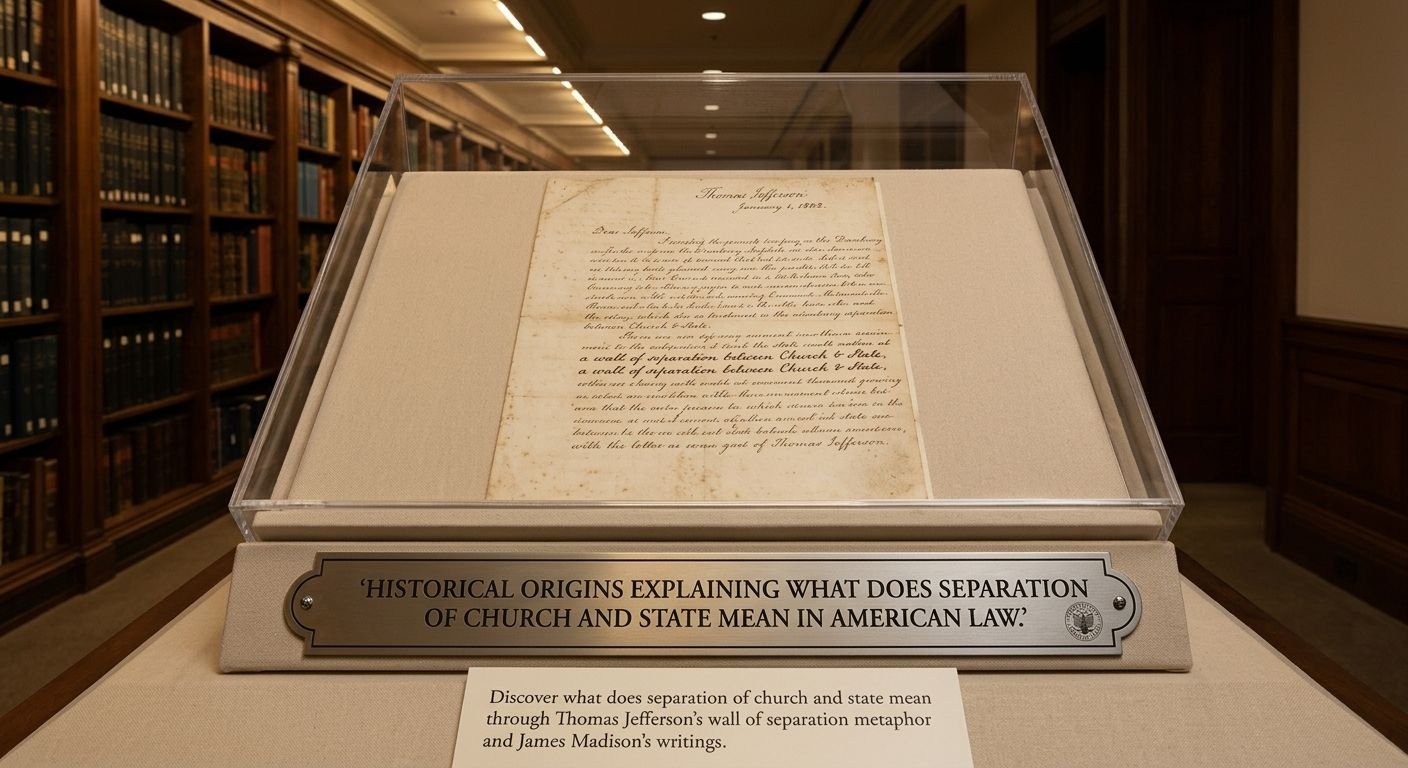
The expression “wall of separation between church and state” became widely known through a letter written by President Thomas Jefferson on January 1, 1802.
Jefferson wrote the letter as a reply to the Danbury Baptist Association of Connecticut.
The Baptists were concerned about religious freedom and the relationship between their religious community and government authority.
Jefferson explained that the First Amendment protected people’s rights of conscience and prevented government from establishing religion or prohibiting its free exercise. He explained this constitutional principle by describing a clear dividing line between religious institutions and government authority.
The expression later became influential in discussions about constitutional religious freedom and Supreme Court decisions.
However, it is important to understand that Jefferson’s phrase does not appear in the Constitution itself. The actual constitutional language is found in the First Amendment. The separation metaphor is a historical explanation of how some people understood those protections.
Preserved as part of archived constitutional correspondence, Jefferson’s original letter and related historical documents help explain how the phrase developed. These primary records are particularly useful for readers who want to understand the difference between the constitutional text and the historical language commonly used to describe it.
James Madison’s Contribution to Religious Freedom
James Madison also played an important role in developing American religious liberty principles. He believed that religious beliefs should not depend on government permission or financial support.
Madison opposed government involvement in establishing religious authority and supported protecting individual conscience. His ideas influenced the development of the First Amendment and the broader understanding that religious freedom belongs to individuals rather than being granted by political officials.
The Library of Congress documents Madison’s opposition to certain government-supported religious practices, including public funding for legislative chaplains. His writings show that the separation principle was part of a larger discussion about the proper limits of government power.
Jefferson and Madison did not always approach every religious question in exactly the same way, but both contributed significantly to the American tradition of religious liberty.
How Does Separation of Church and State Work in Everyday Life?
The principle becomes easier to understand when it is applied to situations people may encounter at school, work, and in their communities.
Religion in Public Schools
Public schools are government institutions, so they must respect constitutional limits concerning religious activity. A school cannot organize mandatory religious worship, pressure students to participate in prayer, or present a particular faith as the school’s official belief.
However, students do not lose their personal religious freedoms when they enter a public school. They can generally pray privately, discuss religious beliefs, wear religious clothing, and participate in permitted religious expression under the same neutral rules that apply to other students.
For example, imagine a student who wants to pray silently before an examination. A school cannot automatically prohibit the student simply because the activity is religious. Personal religious expression is different from a school organizing and leading a prayer.
Another important distinction involves school employees. Teachers and other public employees have their own constitutional rights, but their actions must be evaluated in light of their official responsibilities and the circumstances in which they express religious beliefs.
In Kennedy v. Bremerton School District (2022), the Supreme Court ruled in favor of a public-school football coach who engaged in a brief, personal prayer after games. The Court concluded that the school district violated his First Amendment rights by disciplining him for that protected religious exercise.
The decision demonstrates why it is inaccurate to assume that every religious expression by a public-school employee automatically violates the separation principle. Personal expression and government-sponsored religious activity are different constitutional questions.
Religious Expression in Government Buildings
People sometimes see religious references, displays, or expressions inside government buildings and wonder whether they violate constitutional rules.
The answer depends on the circumstances. A private individual may express religious beliefs in a public building when the applicable rules allow that form of expression. A government employee may also have protected personal religious expression, depending on the situation.
However, a government institution cannot simply use its official authority to declare that one religious tradition represents everyone’s beliefs.
For example, a city government cannot require visitors to participate in a religious ceremony to access ordinary public services. It also cannot make religious membership a condition for receiving a government benefit.
A religious display on government property requires a more specific legal analysis. Courts may consider the purpose, context, history, and manner in which the display is presented. The fact that religious material appears on public property does not automatically establish a constitutional violation.
Religion in the Workplace
Separation of church and state also affects government workplaces, but private workplaces require a different legal analysis.
Public employees generally have constitutional protections for certain personal religious expressions. Government employers need to respect these rights while also meeting workplace requirements and protecting the rights of other employees.
Private employers are not government institutions, so the constitutional separation principle does not apply to them in exactly the same way. However, federal employment discrimination law provides separate protections for religious practices.
Under Title VII of the Civil Rights Act of 1964, most covered employers are prohibited from treating employees unfairly because of their religious beliefs or practices. It also requires reasonable accommodation of sincerely held religious practices unless the employer can establish the applicable legal standard for undue hardship.
For instance, an employee may request a schedule adjustment to observe a religious holiday. The employer must evaluate the request under employment law rather than automatically rejecting it because it involves religion.
This example shows why it is important not to confuse constitutional restrictions on government with workplace protections that apply under separate federal laws.
Religious Organizations and Government Funding
Another common question concerns whether religious organizations can receive public money.
Separation of church and state does not mean religious organizations are automatically excluded from every government program. A religious organization may qualify for a public benefit when the program uses neutral eligibility requirements and treats qualifying organizations fairly.
For example, a religious nonprofit may apply for a government grant that is available to nonprofit organizations providing certain community services. Its religious identity alone does not necessarily disqualify it.
However, public funding cannot be used as a simple way for government authorities to establish religious worship or force people to participate in religious activities.
The legal details depend on the program, the conditions attached to the funding, and the constitutional rules governing that particular situation.
The practical lesson is that government neutrality does not always require excluding religious organizations. It requires treating religious and nonreligious participants according to applicable constitutional and legal standards.
Does Separation of Church and State Mean Religion Cannot Influence Politics?
No. Separation of church and state does not prevent religious people from participating in political discussions or supporting candidates who reflect their values.
Americans have the right to discuss public issues through religious, moral, philosophical, or personal perspectives. A religious organization can express views about government policies, and an individual can vote according to personal religious convictions.
For example, a Christian voter may support a candidate because of that candidate’s position on poverty or family policy. A Muslim voter may evaluate candidates according to their views on civil rights or international affairs. A person with no religious affiliation may make political decisions based on secular ethical principles.
These activities are part of public participation.
The constitutional concern arises when government authority is used to establish religion, favor one faith over others, or restrict religious exercise unfairly.
It is also important to distinguish between a politician discussing personal religious beliefs and a government requiring citizens to accept those beliefs. A public official can speak about faith in a personal capacity, but official government actions remain subject to constitutional limits.
In other words, religious citizens can participate in democracy, but government power cannot be used to turn personal religious convictions into compulsory beliefs for everyone.
Common Misunderstandings About Separation of Church and State
One reason this principle creates so much debate is that people often treat it as a complete ban on religion in public spaces. Others interpret it as permission for government institutions to promote religious beliefs. Both approaches overlook important constitutional distinctions.
It Does Not Mean People Must Keep Religion Private
Religious freedom includes the ability to express personal beliefs in public. People can wear religious clothing, discuss faith, attend religious gatherings, and participate in peaceful religious activities.
The government generally cannot silence these activities simply because they involve religion. The constitutional protection belongs to religious individuals as well as people who do not practice religion.
It Does Not Mean America Has an Official Religion
The U.S. Constitution does not establish any official national religion.
Government institutions cannot declare that citizens must follow one particular faith.
However, individuals and private organizations remain free to practice and promote their religious beliefs within the law.
It Does Not Mean Government Must Treat Religion Unfavorably
Government neutrality is not the same as hostility toward religion. A government institution should not discriminate against a person simply because that individual expresses a religious belief.
For example, excluding someone from a generally available public benefit solely because of their religious identity can raise serious constitutional concerns.
It Does Not Remove Religion From American History
Religion has played a significant role in American history, including social movements, political debates, education, and community life. Separation of church and state does not require people to ignore that history.
The principle concerns the constitutional relationship between religious authority and government power, not the removal of all religious references from historical or cultural discussions.
What Should You Do If You Believe a Government Institution Is Violating Religious Freedom?
Understanding constitutional principles is useful, but knowing how to respond to a possible violation is equally important. Not every disagreement involving religion is a constitutional violation. The details of the situation matter.
If a public school appears to be forcing students to participate in religious activities, start by identifying what actually happened. Determine whether the activity was organized by school officials, whether students were pressured to participate, and whether private religious expression was involved.
If the concern involves a government workplace, examine whether an employee is expressing personal beliefs or whether the government institution is officially promoting a religious message. These situations can involve different constitutional protections.
It is also helpful to preserve relevant information. Keep copies of written policies, official communications, notices, and other documents that explain the institution’s actions. If possible, record dates and describe what happened without exaggerating or making assumptions about someone’s intentions.
For employment-related concerns, consider whether Title VII or another applicable law provides protection. For constitutional disputes involving government institutions, an attorney familiar with First Amendment law can help evaluate the circumstances.
The important thing is to identify the specific action that may violate someone’s rights rather than relying only on general disagreement about religion in public life.
Why Does Separation of Church and State Still Matter Today?
Religious diversity makes the separation principle especially important in modern American society. People follow different faiths, interpret religious teachings differently, and sometimes choose not to practice any religion.
Without constitutional protections, government officials could potentially use political authority to favor one religious community over another. People who hold minority beliefs could face unequal treatment, while those without religious beliefs might feel pressured to follow practices they do not accept.
The principle provides a common constitutional framework for people with different beliefs to live under the same government.
It also protects religious organizations from government interference in matters that properly belong to their institutions. Government officials should not have unlimited authority to determine religious teachings, select religious leaders, or control ordinary worship.
At the same time, religious institutions must follow applicable laws when operating within society. Religious freedom does not create an unlimited exemption from every legal responsibility.
This balance is what makes the subject important. Separation protects both the freedom of individuals to practice religion and the constitutional limits that prevent government from establishing religious authority.
Conclusion
So, what does separation of church and state mean in the United States? It means government power and religious authority have separate constitutional roles, protecting people from government-established religion while preserving their freedom to practice their beliefs.
The First Amendment provides the foundation through the Establishment Clause and Free Exercise Clause. Together, these provisions prevent the government from establishing an official religion and protect individuals from unfair restrictions on religious practice.
The principle does not mean religion must disappear from public life, nor does it prevent religious people from participating in political discussions. Instead, it establishes limits on how government institutions can interact with religion.
Understanding this distinction makes it easier to evaluate questions involving public-school prayer, religious clothing, government funding, workplace accommodations, and political expression.
Ultimately, the purpose of separation is to protect freedom of conscience. People should be able to follow a religion, change their beliefs, or choose not to practice any religion without government pressure. That freedom is an important part of the American constitutional system.