
During fast-moving geopolitical crises, military conflicts, and international security emergencies, everyday news consumers and intelligence analysts face an immediate challenge: separating verified breaking developments from viral rumors and unconfirmed reports. As traditional media outlets work through lengthier editorial cycles, millions of users turn to real-time open-source intelligence aggregators across social media platforms. In this fast-paced environment, accounts such as OSINTdefender X have become prominent hubs for real-time monitoring, aggregation, and synthesis of military and conflict imagery.
However, relying on social media aggregators presents distinct information security risks. Readers trying to understand breaking reports often struggle to evaluate source reliability, verify geolocated video footage, and discern whether a post reflects confirmed facts or early, fluid speculation. Gaining a professional understanding of how OSINTdefender X aggregates open-source intelligence, recognizing the inherent limits of real-time crowd-sourced reporting, and learning structured verification methodologies empowers individuals to consume breaking news with analytical rigor rather than panic.
Understanding Open-Source Intelligence in the Social Media Era
To evaluate the role of accounts like OSINTdefender X effectively, one must first understand how open-source intelligence, commonly known as OSINT, functions within modern information ecosystems. Open-source intelligence involves gathering, analyzing, and synthesizing publicly accessible data—such as commercial satellite imagery, flight tracking logs, maritime AIS feeds, local social media uploads, and official government releases—to reconstruct real-world events.
In earlier decades, intelligence analysis was largely restricted to government agencies and specialized defense firms with proprietary collection systems. Today, the democratization of technology enables independent researchers and automated monitoring bots to aggregate vast quantities of data almost instantaneously. Utilizing professional legal research platforms helps analysts track public records effectively. Accounts like OSINTdefender X leverage these public data streams to provide immediate situational awareness, bridging the gap between raw, on-the-ground social uploads and structured policy analysis for a global audience.
How OSINTdefender X Aggregates and Distributes Conflict Data
The operational process behind popular monitoring channels like OSINTdefender X relies on continuous digital monitoring across multiple communication networks. Analysts and automated feeds sweep local news aggregators, messaging channels, civilian video uploads, and public emergency frequencies. When a significant kinetic event, troop movement, or air strike occurs, the account synthesizes these fragmented data points into concise posts for rapid distribution on the X platform.
This aggregation model delivers clear benefits in terms of speed, offering immediate visibility into developing regional crises long before official press conferences occur. However, the speed-versus-accuracy tradeoff remains an ongoing challenge. When accounts operate at real-time speeds, early reports may incorporate unverified civilian claims, mistranslated local reporting, or recycled historical footage. Understanding this operational workflow helps followers appreciate the immediacy of OSINTdefender X posts while maintaining healthy skepticism regarding initial breaking claims.
The Risk of Misinformation and the Importance of Geolocation
A central concern for anyone following real-time conflict feeds is the risk of misattribution, psychological operations, and deliberate misinformation. In modern asymmetric warfare, state and non-state actors frequently release altered imagery, old footage presented as new events, or fabricated combat video to influence public perception. Even well-intentioned aggregators can inadvertently amplify misleading content if verification checks are rushed during breaking news spikes.
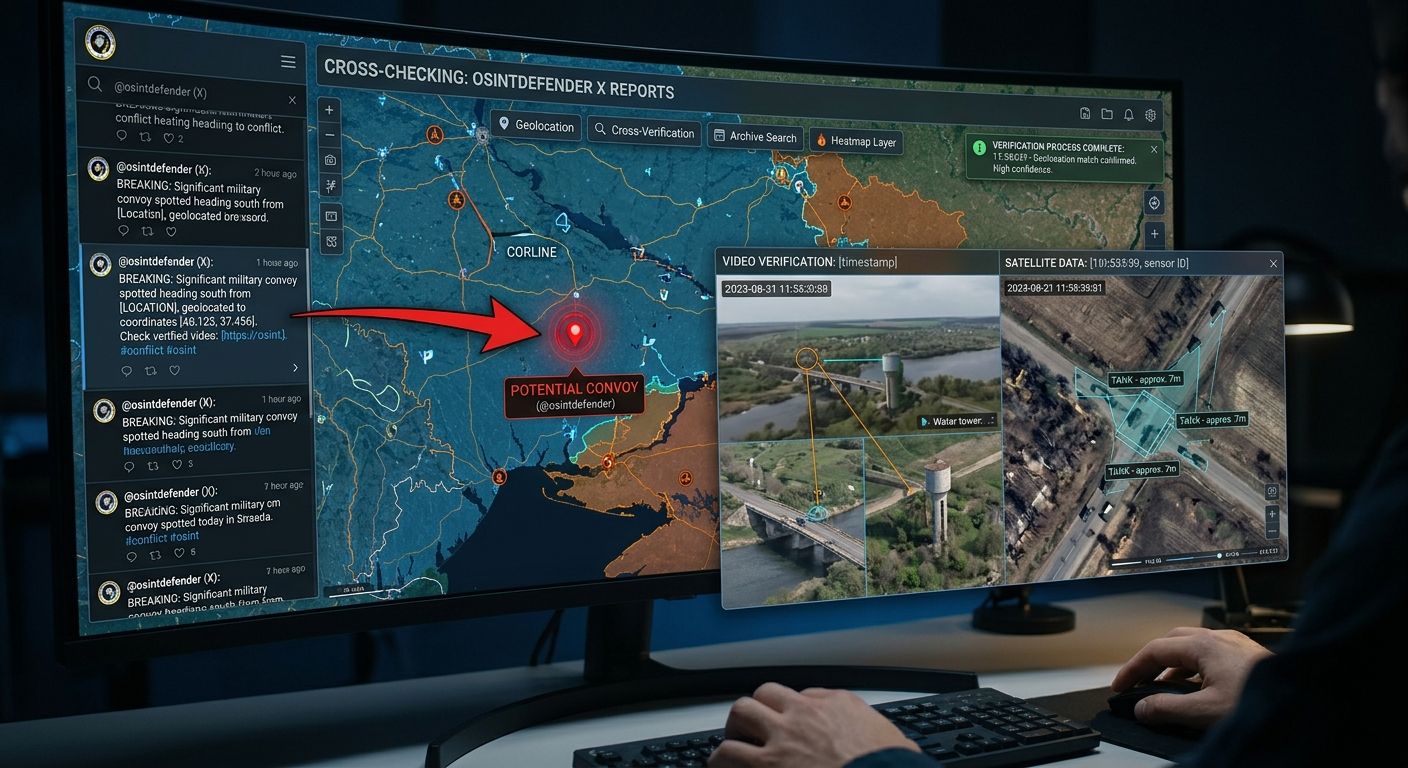
Professional open-source verification relies heavily on techniques like geolocation and chronolocation to validate visual evidence. Experienced analysts utilize structured digital verification methodologies to confirm satellite coordinates and verify media authenticity. Analysts cross-reference background terrain features, architectural structures, and shadow angles against high-resolution satellite imagery and historical weather data to confirm precisely where and when a video was recorded. While OSINTdefender X frequently highlights geolocated maps and verified satellite passes, readers should remember that unverified initial posts require secondary confirmation through established methodologies before being accepted as factual record.
Evaluating Source Authority: Aggregators vs. Primary Intelligence Researchers
For decision-makers, journalists, and security researchers, distinguishing between primary OSINT researchers and secondary intelligence aggregators is crucial. Primary researchers specialize in deep, focused domains—such as tracking specific radar systems, verifying naval vessel movements, or conducting rigorous frame-by-frame video forensics. These experts usually publish detailed, peer-reviewed methodology threads explaining exactly how they reached their conclusions.
In contrast, secondary aggregators like OSINTdefender X act primarily as information curators, collecting findings from primary researchers, local wire services, and user submissions to present a broader regional overview. While curation provides excellent high-level situational awareness, it can occasionally obscure original attribution or miss subtle analytical nuances. Recognizing where OSINTdefender X sits within the broader intelligence hierarchy allows readers to use its feed as a starting directory for breaking events rather than an absolute single point of truth.
Practical Verification Strategies for Following OSINTdefender X
When monitoring fast-moving updates on OSINTdefender X during active security situations, adopting a structured personal verification framework prevents falling victim to premature conclusions or sensationalized narratives. Applying systematic cross-checking techniques allows readers to process breaking intelligence efficiently while filtering out emotional noise.
First, cross-reference breaking posts from OSINTdefender X against official primary documentation, such as government defense releases, official emergency management channels, and accredited international news wire agencies. If a major military development is reported, check whether professional investigative networks or established satellite imagery providers have independently corroborated the claim. Second, inspect media attachments carefully for signs of reuse; performing a reverse image search on screenshots or video stills often reveals whether dramatic footage originated in past conflicts or alternate regions.
Third, monitor community notes and secondary commentary threads beneath posts on OSINTdefender X to see if specialized analysts have raised methodological objections or identified technical inconsistencies. Finally, track updates over a 24-to-48-hour window. Real-time intelligence reports frequently undergo revision as clearer satellite passes and official damage assessments become available. Allowing initial breaking claims time to mature ensures that personal and professional decisions are based on confirmed facts rather than initial speculation.
Managing Information Fatigue and Cognitive Bias in Real-Time Feeds
Following high-volume intelligence channels during active military operations exposes users to extreme amounts of disturbing visual content, conflicting reports, and constant notification alerts. This continuous stream of information often triggers cognitive fatigue, making readers susceptible to confirmation bias—the tendency to accept unverified claims simply because they align with existing geopolitical preferences or personal expectations.
To maintain analytical objectivity while following OSINTdefender X, set intentional boundaries around social media consumption during global crises. Avoid making immediate financial, travel, or analytical decisions based solely on initial breaking posts. Step back from live feeds periodically to review consolidated daily summaries produced by established defense institutes. Treating accounts like OSINTdefender X as real-time signaling tools rather than definitive final reports helps preserve mental clarity and analytical independence during turbulent international events.
Future Outlook for Open-Source Intelligence on Social Platforms
As artificial intelligence models, deepfake video generators, and automated propaganda networks become increasingly sophisticated, the landscape surrounding open-source intelligence will undergo rapid transformation. Channels like OSINTdefender X will face mounting pressure to implement automated authentication protocols, cryptographic media signing, and advanced forensic verification tools to maintain audience trust amid a flooding tide of synthetic content.
Ultimately, open-source intelligence remains one of the most powerful tools for global transparency and public awareness when utilized responsibly. Accounts such as OSINTdefender X provide invaluable real-time visibility into world events, provided their output is consumed with critical thinking, methodical cross-verification, and an understanding of real-time limitations. By combining real-time social aggregation with rigorous verification standards, citizens and professionals can navigate complex geopolitical developments safely, accurately, and with confidence.
Frequently Asked Questions
What is OSINTdefender X?
OSINTdefender X is a widely followed social media account on the X platform that aggregates, synthesizes, and broadcasts real-time open-source intelligence, military updates, and geopolitical breaking news from around the world.
Is information posted on OSINTdefender X always 100% verified?
No. While OSINTdefender X strives to aggregate accurate intelligence from various public feeds, real-time reporting during breaking crises inherently carries a risk of unverified reports, early inaccuracies, or misattributed media that require subsequent correction.
How does OSINTdefender X gather its information?
The account gathers data by monitoring public satellite feeds, local social media uploads, flight and maritime tracking data, radio transmissions, and contributions from independent open-source researchers worldwide.
What is the difference between OSINTdefender X and traditional news outlets?
OSINTdefender X prioritizes immediate, real-time aggregation and raw situational awareness, whereas traditional news outlets typically follow slower editorial cycles involving multi-source verification and formal editorial oversight before publication.
How can I verify a video or image shared by OSINTdefender X?
You can verify shared media by conducting reverse image searches, checking whether independent primary researchers have geolocated the terrain, and cross-referencing the claims against verified satellite imagery or official statements.
Why is open-source intelligence important during international conflicts?
Open-source intelligence provides public transparency, helps verify battlefield claims independently of state propaganda, documents potential human rights violations, and allows global audiences to track security developments in real time.