
Plenty of truck owners reach the same point. The factory horn sounds like a polite beep, a driver drifts into your lane on the highway, and you wish you had something that could actually get attention. That frustration is the usual starting point for anyone searching for a train horn for truck use. The idea is simple, but the details are not. A loud air horn needs the right compressor, enough stored air, proper mounting, careful wiring, and a clear understanding of local noise rules. Skip any of those pieces and you end up with a weak sound, a dead compressor, or a ticket.
This guide walks through the whole decision. It explains what makes these horns different from a standard horn, what hardware you actually need, how to choose among the available setups, how installation works in broad terms, and where people commonly go wrong. It also addresses the legal side honestly, because the rules vary by location and I cannot tell you what applies in your town. By the end, you should know whether this upgrade suits your situation and what to do next.
Why a Standard Truck Horn Often Disappoints
Factory horns are designed to meet a minimum requirement, not to cut through highway noise. Most are small electric diaphragm units that produce a modest sound, and they are tuned to be tolerable for neighbors and passengers. In a quiet parking lot they work fine. On a loud interstate, with windows up and a diesel engine running nearby, the sound barely registers with drivers in other vehicles.
That gap in performance is what pushes people toward an air horn. Instead of a vibrating electric diaphragm, an air horn uses compressed air that rushes through a diaphragm or valve into one or more trumpets. The air moves a lot more energy than a small electric motor can, which is why the sound is deeper, louder, and carries farther. When someone says they want a train horn for truck driving, they are almost always describing this kind of compressed air system.
What a Real Train Horn Setup Includes
The horn itself is only one part of the system. Understanding the full list of components helps you avoid buying a kit that cannot do what the packaging promises.
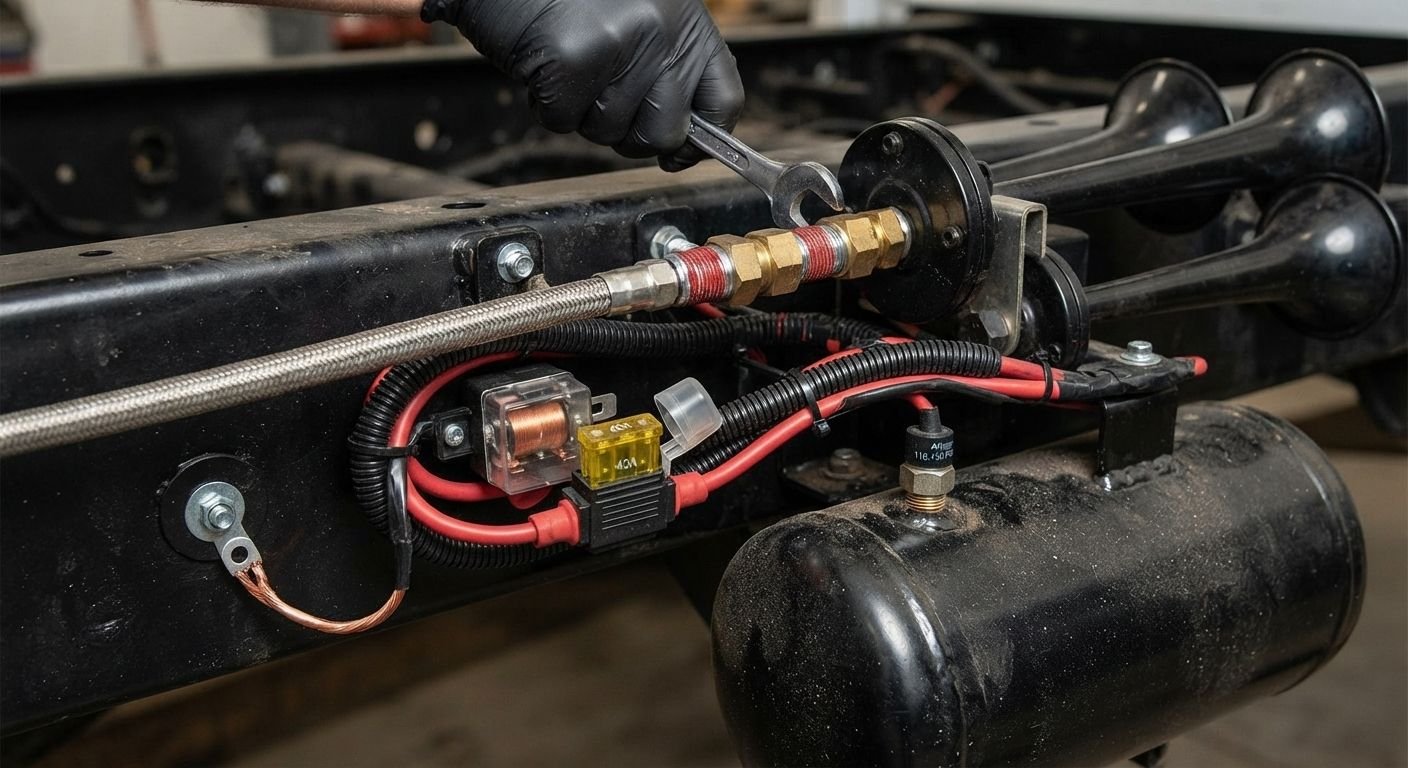
A compressor supplies the air. Small twelve-volt compressors fill a tank slowly, and larger ones fill it faster. The air tank stores that compressed air so it is available instantly when you press the button. Without a tank, the horn would have to rely on the compressor alone, and the sound would be weak and short. The tank is what lets you deliver a strong blast, and its size determines how long you can sound the horn before pressure drops.
An electric solenoid valve is installed between the tank and the air horns.
When you press the horn button, the valve opens and releases air. Air line, fittings, and a pressure switch complete the plumbing. The pressure switch tells the compressor when to turn on and off, so the tank stays in a usable pressure range. Finally, there is the wiring, which includes a relay, fuse, and a switch or steering wheel connection so the horn can be triggered safely.
Trumpets come in different lengths and counts. Single-trumpet setups are compact and affordable. Multi-trumpet setups, often marketed as three-chime or four-chime, produce a layered sound closer to what you hear from a locomotive. Longer trumpets tend to produce deeper notes, but they also demand more space and more air.
Understanding Decibels and What They Mean in Practice
Product listings often advertise very high decibel numbers, sometimes in the range of 150 or more. Treat those numbers with caution. Manufacturers measure sound at different distances and under different conditions, and the numbers are not standardized across brands. A claim made from a few inches away is not comparable to a measurement taken at a standard distance.
What matters more for your decision is how the horn will be used. According to federal guidance on noise exposure and hearing damage, sustained high volumes become a genuine health concern, and a very loud horn sounded close to people can cause real harm, especially to children, pets, and anyone not expecting it. A horn that is loud enough to be heard clearly in traffic is a reasonable goal. A horn that is dangerously loud to bystanders is not an upgrade, it is a liability.
Is a Train Horn for Truck Use Legal?
This is the section many articles skip, and it is the one that can cost you the most. Vehicle horn laws in the United States are set mostly at the state and local level, and they differ widely. Many jurisdictions require that a vehicle horn be audible from a certain distance, commonly several hundred feet, and some also prohibit horns that make an unreasonably loud or harsh sound. Others restrict the use of horns except as a warning to avoid a collision. Some states have specific language about sirens, whistles, or sounds that could be mistaken for emergency or railroad signals.
Because of that variety, I cannot tell you that any particular setup is legal where you live.
What I can tell you is how to find out. Check your state vehicle code and any local noise ordinance, and consider calling your state motor vehicle agency or a local law enforcement non-emergency line to ask directly. If you take your truck through periodic inspection, ask whether an aftermarket air horn affects the result.
A practical approach used by many owners is to wire the air horn to a separate switch while keeping the factory horn functional for everyday use. That arrangement lets you reserve the loud horn for genuine emergencies and use the stock horn for light tapping, which also reduces the chance of unnecessary complaints. It does not change what the law says about use, but it keeps your daily driving reasonable.
It is also worth saying plainly that blasting a train horn to startle people, harass drivers, or draw attention in residential areas can lead to fines and, in some cases, more serious consequences. Using the horn responsibly protects both your record and your neighbors.
Choosing the Right Train Horn for Truck Needs
The best choice depends on your truck, your use case, and your tolerance for installation work. Start by thinking honestly about what you want the horn to do.
If you mainly want a stronger warning sound for highway safety, a compact single-trumpet or dual-trumpet system with a modest tank is often enough. These setups fit more easily on smaller pickups and are less likely to run into legal or social problems. They also draw less current and need less space.
If you want the full locomotive sound, you will need a multi-trumpet setup, a larger tank, and a compressor that can keep up. These systems are bulkier, and fitting them under a half-ton pickup can be a challenge. Many owners mount the tank and compressor on the frame rails, under the bed, or in the bed itself, and the trumpets under the truck or behind the bumper.
Consider your available space first. Measure the room beneath your truck, check the clearance for the tank, and remember that trumpets need to point somewhere they will not be blocked or hit by road debris. A great kit that does not physically fit is a waste of money.
Think about your electrical system as well. A compressor draws significant current when it runs. Many kits include a relay and heavy-gauge wire for this reason, but an older truck with a weak battery or tired alternator may struggle. If your charging system is already marginal, plan for that before you add another load.
Finally, consider the quality of the components. Cheap kits sometimes use plastic fittings, undersized compressors, or thin wiring that overheats. A reputable manufacturer with clear specifications and a customer support line is generally a better bet than an unfamiliar listing with an eye-catching decibel claim and no technical details. Read reviews carefully, and focus on comments from owners who have used the system over time rather than those who just unboxed it.
Compressor and Tank Sizing, Explained Simply
Many first-time buyers are confused by sizing, so it helps to think about it as a simple balance. The tank stores the compressed air, while the compressor determines how quickly it gets refilled.
A larger tank lets you sound the horn longer or more often before pressure drops. A faster compressor refills the tank sooner after you use it.
For occasional use, such as a short blast now and then, a smaller tank and a modest compressor can work well. For heavier use, or if you want a long, sustained blast, a bigger tank makes a noticeable difference. Operating pressure matters too. Most kits are designed to work within a specific pressure range, and running outside it can reduce sound quality or stress the components. Always check the manufacturer’s recommended pressure and match your compressor and pressure switch to it.
Duty cycle is another detail people overlook. Many small compressors are not designed to run continuously. They need rest periods to avoid overheating. If you plan to use your system frequently, look for a compressor with a duty cycle rating that matches your expected use, and follow the manufacturer’s guidance on run time.
Installation Overview and Where Things Go Wrong
I am not going to present a complete step-by-step wiring guide here, because the correct procedure depends on your specific kit and truck, and a mistake can cause fires or electrical damage. What I can offer is an overview of the process and the issues that cause most problems.
Installation usually begins with planning the layout. You decide where the tank, compressor, and trumpets will go, and you route air lines and wiring between them. Good layouts keep the compressor away from heat and water, keep the tank accessible for draining, and keep the trumpets pointed downward or sideways so water does not collect inside them. Moisture is a persistent issue with any compressed air system, and a drain valve on the tank helps you release condensation regularly.
The wiring stage is where many do-it-yourself projects run into trouble. The compressor should have its own fused power wire running directly from the battery, while a relay operated by the pressure switch controls it.
The horn valve needs its own relay and switch. Using wire that is too thin, skipping fuses, or tapping into existing circuits that are not designed for the load can cause overheating or blown fuses. If you are not comfortable with automotive electrical work, paying a professional installer is a sensible investment.
Air leaks are another frequent issue. Every fitting in the system must be tight and, where required, sealed with thread sealant suitable for compressed air. A small leak can make the compressor cycle constantly, which wears it out and drains the battery. After installation, fill the tank, shut off the compressor, and listen for hissing. A tank that loses pressure overnight has a leak somewhere.
Mounting is the last piece. Compressors vibrate, so mounting them on rubber isolators and checking bolts periodically helps prevent cracks and loose connections. Trumpets should be secured so they do not rattle or shift.
Common Mistakes Truck Owners Make
The most common mistake is buying on decibel claims alone. A listing that promises a huge number often hides a small tank, a weak compressor, or poor construction. Sound quality, reliability, and fit matter much more than a headline figure.
Another mistake is ignoring the legal side. Owners sometimes install a system, use it in a neighborhood, and discover that local noise rules apply. Doing a bit of homework before buying can save you money and conflict later.
Undersizing the electrical system is another recurring problem. A compressor that pulls more current than the wiring or battery can handle leads to blown fuses, dimming lights, or a dead battery. Matching wire gauge and fuse size to the manufacturer’s recommendation, and checking that your charging system is healthy, prevents most of these issues.
Neglecting maintenance is the final common error. Tanks collect moisture, and water inside a tank can rust it from the inside and freeze in cold weather, potentially blocking lines or damaging valves. Draining the tank regularly, inspecting fittings, and checking the compressor for wear keeps the system healthy.
Safety Considerations You Should Not Skip
Compressed air stores energy, and a tank is a pressure vessel. Use tanks rated for the pressure you plan to run, and never exceed the manufacturer’s maximum. Inspect tanks for rust, dents, or damage, and replace any that look compromised. A failed tank can be dangerous.
Consider the safety and comfort of those around you, too.
A loud horn sounded unexpectedly can startle other drivers, and a startled driver can swerve. Use the horn the way a horn is meant to be used, as a warning to prevent a collision, and avoid using it as a joke or a show of dominance. That is better for road safety and for your own legal exposure.
Protect your hearing and the hearing of passengers. If you are working near the trumpets during testing, wear hearing protection. Testing the horn in a controlled environment, away from people and animals, is a good habit.
Budget and Cost Expectations
Pricing for a complete system varies widely depending on the number of trumpets, the quality of components, and the size of the compressor and tank. Entry-level kits cost much less than premium systems with heavy-duty compressors and large tanks, but the cheapest options often cost more in the long run through repairs and replacements. I will not quote specific figures, because prices change and differ among sellers, but a reasonable expectation is that a reliable, well-matched setup costs noticeably more than a budget kit with questionable parts.
Remember to include installation costs if you plan to hire a shop, and extras such as fittings, a drain valve, wire, fuses, and mounting hardware if they are not included. A kit that looks inexpensive can become costly once you add the necessary extras.
Alternatives Worth Considering
If your main goal is a louder warning rather than a locomotive sound, there are simpler paths. Upgrading to a higher-quality electric horn pair can improve volume and tone significantly without the complexity of an air system. Compact electric horns are easier to install, draw less current, and are less likely to attract attention from local authorities.
Some owners also choose a hybrid approach, keeping the factory horn for everyday use and adding an air horn on a separate button for emergencies. This lets you keep a normal daily sound while having a powerful option available when you truly need it. For many drivers, that balance is the most sensible way to add a train horn for truck use without annoying everyone nearby.
Maintaining Your System Over Time
A properly installed system can work reliably for years with only basic maintenance.
Drain the tank on a regular schedule, especially in humid climates or before winter. Check air line connections and fittings occasionally for leaks, and look at the wiring for chafing, corrosion, or loose terminals. Listen to the compressor, since a change in sound or a longer fill time often signals wear.
Protect trumpets from road debris and water by checking their orientation and mounting. If you drive in winter conditions, consider how road salt and cold weather affect exposed components, and take extra care to keep moisture out of the system. A little attention every few months prevents most failures.
Final Thoughts on Adding a Train Horn for Truck Use
An air horn upgrade can make a real difference in how well your truck is heard on the road, but it works best when you treat it as a system rather than a single part. The right train horn for truck use depends on your available space, your electrical capacity, your realistic needs, and the rules in your area. Choose quality components, plan the layout carefully, take wiring seriously, and verify local laws before you install or use the horn.
If you stay realistic about why you want the upgrade, match the components to one another, and use the horn responsibly, you will likely end up with something that improves safety and gives you real satisfaction. If any part of the process feels beyond your comfort level, especially the electrical work, a professional installer is a worthwhile expense. The goal is a horn that works reliably when you need it and never gets you into trouble.