

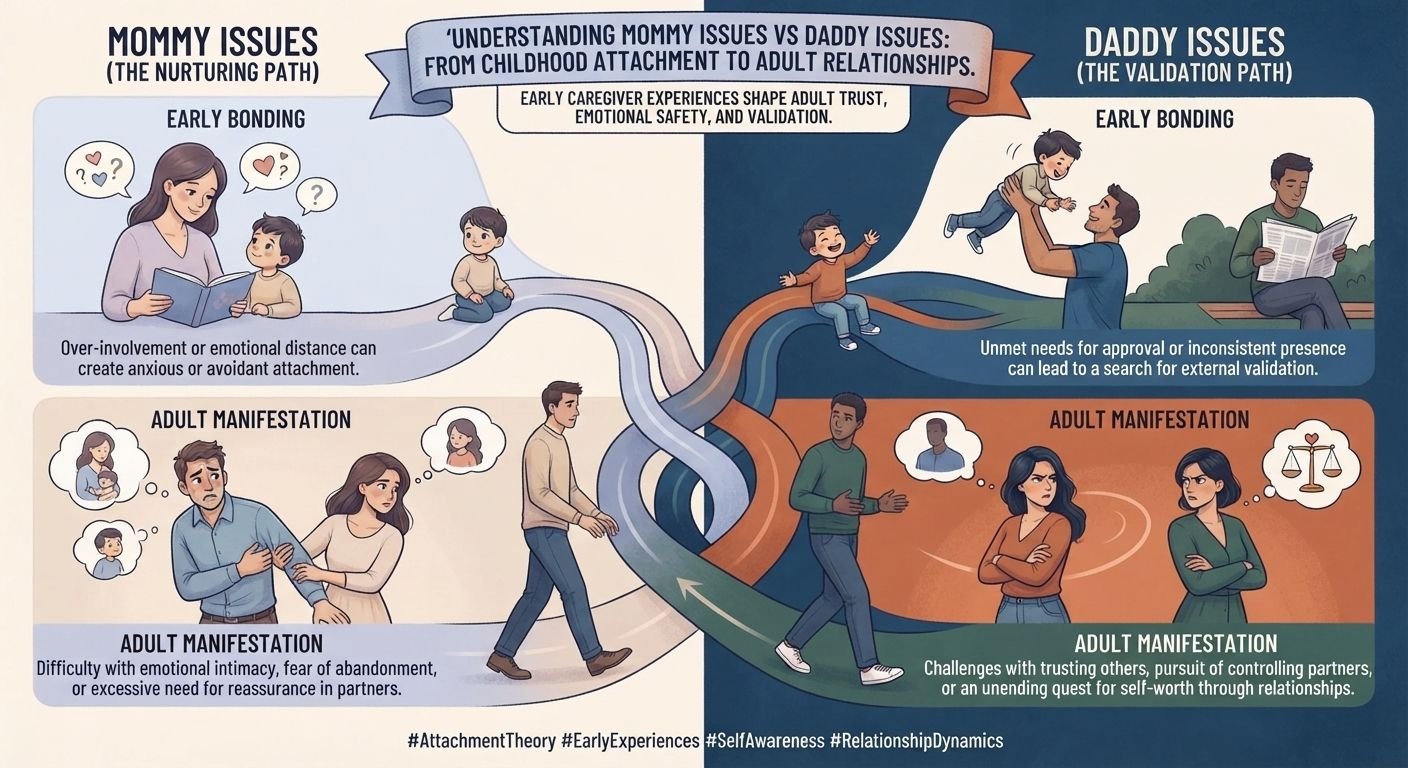
Most people who search for mommy issues vs daddy issues are not looking for a label to throw at someone. They are usually trying to understand a pattern in their own life, or in the life of someone they love. Maybe you keep choosing partners who feel emotionally unavailable. Maybe you panic when someone gets close, or you feel an oddly intense need for approval from authority figures. You have heard both phrases used online, often as insults, and you want to know whether either one explains what you are living through.
This guide treats the topic seriously. It explains where the two phrases come from, how the patterns tend to differ, why they often overlap, and what you can realistically do to change them. One caution up front: neither phrase is a clinical diagnosis. They are everyday shorthand for how early experiences with a mother or father can shape adult emotional habits. Psychology has better language for those habits, and that language leads to better solutions.
What People Mean When They Talk About Parental Issues
In casual conversation, “mommy issues” usually describes difficulty with trust, intimacy, or self-worth that is traced back to a strained relationship with a mother or mother figure. “Daddy issues” does the same for a father or father figure. In pop culture the terms have picked up stereotypes. Women are often mocked for the second, and men for the first. Those stereotypes are unfair and mostly inaccurate, because people of every gender can carry wounds from either parent.
Behind the slang sits a widely accepted idea in developmental psychology: the first close relationships of our lives teach us what to expect from other people. Research on early caregiver attachment patterns, started by John Bowlby and expanded through the work of Mary Ainsworth, describes how children learn whether caregivers are reliable, whether their feelings are welcome, and whether love is steady or conditional.
Those lessons do not vanish at eighteen. They tend to become the unspoken rules we bring into romance, friendship, and work.
It is also important to be honest about what the research can and cannot say. Early experiences influence adult relationships, but they do not seal anyone’s fate. Temperament, later relationships, culture, and personal effort all matter. Anyone who tells you that a single parent explains your entire personality is oversimplifying.
Mommy Issues vs Daddy Issues: Looking at the Difference Through Attachment
The cleanest way to compare mommy issues vs daddy issues is to ask what each parent typically represents to a child. This is a generalization, not a law, and families vary enormously. A father can be the main source of comfort, and a mother can be the disciplinarian. Still, many people describe a pattern in which the mother relationship shapes their sense of emotional safety, while the father relationship shapes their sense of worth, approval, and standing in the world.
How the mother-centered pattern often appears
When the wound centers on a mother, the difficulty usually lives in the emotional layer of life. A child whose mother was critical, smothering, unpredictable, or emotionally absent may learn that feelings are dangerous or burdensome. As an adult, that person might struggle to name what they feel, might apologize constantly, or might feel responsible for everyone else’s mood. Some become fiercely self-reliant and refuse to ask for help. Others cling, because closeness once felt scarce and they fear losing it again.
A common example is the adult who feels a flash of guilt every time they set a boundary. Their mother may have treated independence as betrayal, so saying no now feels like committing a moral offense. Another example is the person who becomes irritated when a partner tries to take care of them, because being cared for was historically tied to being controlled.
How the father-centered pattern often appears
When the wound centers on a father, the difficulty tends to show up around validation, authority, and the sense of being enough. A child with a distant, harsh, or inconsistent father may grow up wondering what they have to achieve to earn attention. As an adult, they might overwork to prove their value, chase approval from bosses or partners, or feel a strange magnetism toward people who are hard to impress. Others do the opposite and bristle at any authority, because earlier experiences taught them that powerful people cannot be trusted.
Consider someone whose father only showed pride when they won something. In adulthood, that person may feel empty after achievements and anxious during quiet periods, because love once seemed to depend on performance. This is very different from the guilt-and-boundaries struggle described above, even though both come from childhood.
Why the Two Patterns Overlap More Than Most Articles Admit
It is tempting to sort people into one category or the other, but real life is messier. Most people absorbed lessons from both parents, from siblings, and from the way their parents treated each other. A child who watched a mother tolerate disrespect from a father may form beliefs about marriage that have nothing to do with how either parent treated the child directly. A child raised by a single parent may have received a blend of nurturing and discipline from one person.
This overlap is why the debate over mommy issues vs daddy issues can become unhelpful when pushed too far. The more useful question is not which label fits, but which specific beliefs and reflexes you are carrying. Do you believe that people eventually leave? Do you believe love must be earned? Do you believe your needs are too much? Those beliefs are the real targets for change, and they can be traced to either parent or to both.
Absence matters too. A parent who was physically missing through divorce, death, incarceration, or abandonment leaves a different kind of mark than a parent who was present but cold. Grief, confusion, and an idealized or demonized mental image of the missing parent can all follow a child into adulthood. Neglect, overprotection, emotional enmeshment, and unpredictable anger each produce their own signature patterns as well.
How Mommy Issues vs Daddy Issues Can Play Out in Romantic Relationships
Romance is where most people notice the pattern first, because intimacy presses directly on old wounds. Someone with mother-centered difficulties may find themselves in relationships where emotional caretaking becomes the whole job. They give endlessly, resent it quietly, and then feel guilty for resenting it. They may also withdraw when a partner expresses a need, because needs once felt like demands that could swallow them.
Someone with father-centered difficulties may notice a different loop. They might feel most alive around partners who are somewhat distant, because winning over a hard-to-reach person feels familiar. They might interpret a warm, steady partner as boring, then wonder why healthy relationships feel strangely uncomfortable. Or they may test partners constantly, waiting for proof that this person will also fail to show up.
These are tendencies, not predictions. Plenty of people with painful family histories build deeply loving partnerships. The common thread is that the pattern becomes more visible, and more changeable, once you can describe it. Noticing that “I feel panicky when my partner is quiet” is the first step toward choosing a different response than the one your childhood trained into you.
Effects Beyond Romance
The influence of a parental wound reaches well past dating. In friendships, you might notice that you keep people at arm’s length, or that you become the endlessly dependable friend who never receives the same care back. At work, mother-centered patterns can show up as difficulty receiving feedback without feeling shamed, or as people-pleasing that blurs professional boundaries. Father-centered patterns can show up as perfectionism, fear of disappointing managers, or tension with anyone who holds power over you.
Self-image is often where the deepest effects live. A person may carry a quiet narrative such as “I am a burden” or “I am only valuable when I perform.” These stories feel like facts to the person holding them. Part of healing is learning to treat them as old conclusions drawn by a child with limited information, not as accurate descriptions of who you are today.
Mistakes That Keep People Stuck
The first mistake is using the phrases as accusations. Telling a partner they have daddy issues, or telling a friend they have mommy issues, usually ends the conversation rather than opening it. These terms carry stigma, and they reduce a complicated person to a stereotype. If you want to raise a concern, describe the behavior and its impact instead of diagnosing the cause.
The second mistake is blaming without processing. Some people spend years rehearsing everything a parent did wrong while never changing their own present behavior. Understanding your history is valuable, but explanation is not the same as transformation. The goal is not to find a villain. It is to stop automatically repeating old strategies that no longer serve you.
The third mistake is swinging into the opposite extreme. A person who felt smothered may decide never to depend on anyone. A person who felt abandoned may decide to hold on to every relationship at any cost. Both responses are reactions to the past rather than choices made in the present. A healthier target sits between them, where you can be close to others and still remain yourself.
Another common mistake is expecting your partner to take on the role of a parent.
A loving partner can offer comfort and consistency, but they cannot repair a childhood. When one person tries to make up for every unmet need from the past, the relationship tends to buckle under the weight.
The fifth mistake is assuming that confronting the parent is required. Some people benefit from honest conversations with a mother or father. Others find those conversations unsafe or fruitless, particularly if the parent is unwilling to take responsibility. Healing does not depend on getting an apology. What matters is how you apply your own understanding.
Practical Steps Toward Healing
Start by gathering evidence about your own patterns. Over a few weeks, notice moments when your reaction feels bigger than the situation deserves. A delayed text, a critical comment, or a canceled plan can set off intense feelings. When that happens, ask yourself what the moment reminds you of. Writing these observations down helps you see recurring themes, such as fear of abandonment, fear of failure, or fear of being controlled.
Next, practice separating past from present. When a strong feeling appears, pause and ask whether this is about the person in front of you or about an earlier relationship. You do not need to answer perfectly. The pause itself creates room for a different choice, such as asking a clarifying question instead of withdrawing or lashing out.
Build skills that your childhood may not have taught. Many adults raised in emotionally difficult homes were never shown how to name feelings, make direct requests, or set calm limits. These are learnable skills. Start with small, low-risk situations, such as telling a friend you need to leave a gathering early without over-explaining, or asking a colleague for clarification without apologizing three times.
Seek out relationships that offer steady, reliable behavior, and give them time. Corrective experiences, where someone shows up consistently and your fears do not come true, are among the most powerful forces for change. This can happen with a friend, a mentor, a partner, or a therapist. The unfamiliar calm of a healthy relationship may feel flat at first. That feeling often fades as your nervous system learns that safety is not the same as boredom.
Finally, extend yourself some compassion. Adults who grew up with criticism often speak to themselves in the same harsh voice. Experiment with responding to your own mistakes the way you would respond to a friend. It sounds small, but changing your inner tone can shift how safe you feel in the world.
When Professional Support Makes Sense
Self-reflection takes you far, but some patterns are too tangled to unravel alone. Consider seeing a licensed therapist if your relationship difficulties repeat despite real effort, if you experience persistent anxiety, depression, or anger, if childhood memories feel overwhelming, or if you suspect that neglect or abuse shaped your upbringing. Approaches such as attachment-focused therapy, cognitive behavioral therapy, schema therapy, and trauma-informed care are commonly used for these concerns. Which approach fits best depends on your history and preferences, and a good therapist will explain their method and adjust it with you.
If you are ever in crisis or having thoughts of harming yourself, contact local emergency services or a crisis line in your region right away rather than waiting for a regular appointment.
Supporting Someone Who Struggles With These Patterns
If you love someone who seems to carry a parental wound, patience and clarity help more than analysis. Avoid diagnosing them, and avoid taking their reactions personally when you can. Be consistent about the small things, like following through on plans and communicating changes, because reliability is exactly what they may be learning to trust. At the same time, protect your own boundaries. Supporting someone does not mean absorbing every emotional wave. You can offer compassion while asking them to take responsibility for their behavior and, if appropriate, to consider counseling.
A Better Way to Think About Mommy Issues vs Daddy Issues
The conversation around mommy issues vs daddy issues becomes far more useful when it moves from labels to patterns. A mother and a father each teach a child something different about safety, worth, and connection, and when those lessons are painful they tend to echo in adulthood in recognizable ways. But the echoes are not destiny. Because these habits were learned, they can be unlearned, and the process usually begins with curiosity instead of shame.
If you take one thing fromthis guide, let it be this: your goal is not to decide which category you belong to. It is to understand what your early relationships taught you, decide which lessons you want to keep, and practice new responses with people who deserve your trust. Whether your story fits mommy issues, daddy issues, or a blend of both, change is realistic, and it usually arrives through small, steady choices rather than dramatic breakthroughs.
Frequently Asked Questions
Are mommy issues and daddy issues real psychological conditions?
No. Neither phrase appears as a diagnosis in clinical manuals such as the DSM-5. They are informal terms for patterns that clinicians would describe using concepts like attachment style, anxiety, people-pleasing, or relational trauma. If your struggles are affecting daily life, a licensed professional can assess what is actually going on.
Can men experience daddy issues, and can women have mommy issues?
Absolutely. Anyone can be shaped by difficult experiences with either parent, regardless of gender. The stereotype that these labels belong to one gender says more about cultural bias than about psychology.
How can I tell if my relationship struggles stem from childhood experiences or other factors?
It is rarely just one source. Present-day stress, personality, past relationships, and health all play a role. A useful signal is repetition: if the same painful dynamic appears across different partners, jobs, or friendships, early learned patterns may be part of the explanation. A therapist can help you sort the contributing factors.
Is it possible to have both at the same time?
Yes, and it is very common. Many people internalized lessons from both parents, or from a parent’s relationship with each other, so the patterns blend. Focusing on specific beliefs and behaviors is usually more productive than choosing a single label.
Do I need to confront my parent to heal?
Not necessarily. Some people find an honest conversation helpful, while for others it is unsafe or unproductive. Healing depends mainly on how you process your experiences and change your current habits, not on whether a parent acknowledges the past.
How long does it take to change these patterns?
There is no reliable timeline, and anyone promising a quick fix is overselling. Many people notice meaningful shifts over months of consistent effort, especially when they combine self-awareness, new relationship experiences, and professional guidance, but progress is often uneven and personal.
Can a healthy relationship help me heal?
It can help, since consistent, respectful treatment gives you new experiences to learn from. But a partner cannot do the work for you or replace therapy when deeper issues are present. Think of a good relationship as a supportive setting for growth, not a cure.