
An automotive key programmer is an electronic diagnostic tool used to register or synchronize a vehicle key with its security system. Depending on the vehicle and the equipment, it may work with a transponder key, remote key fob, or proximity-based smart key. Its main purpose is to help the vehicle recognize an authorized key so the engine can start or the relevant keyless functions can operate.
Modern vehicle keys do more than turn an ignition cylinder. Many contain a transponder chip or electronic credential that communicates with the vehicle’s immobilizer. The immobilizer checks whether the key is authorized before allowing the engine to start. If the vehicle cannot recognize the key, it may refuse to start even when the key blade fits the ignition or door lock.
This is where an automotive key programmer becomes useful. A compatible device communicates with the vehicle’s electronic systems and performs supported key-learning or registration functions. Some tools connect through the OBD-II diagnostic port, while more advanced professional equipment may also support separate key-reading devices or module-level work. The exact process depends on the manufacturer’s security design, vehicle model, and year.
It is important to understand that a programmer does not automatically solve every key-related problem. A damaged key, faulty antenna, weak vehicle battery, communication problem, or defective immobilizer module can create similar symptoms. Choosing the right solution starts with identifying the actual fault rather than assuming that every non-working key needs programming.
How an Automotive Key Programmer Works
A vehicle’s immobilizer system is designed to prevent the engine from starting with an unrecognized key. When a compatible key is presented, its electronic chip communicates with the vehicle. The immobilizer system checks the credential against its accepted security information. If the key is authorized, the vehicle allows the starting process to continue.
An automotive key programmer communicates with the relevant vehicle systems to carry out supported electronic key operations. Depending on the vehicle, these operations may include adding a replacement key, registering a smart key, synchronizing a remote, or carrying out an approved immobilizer-related procedure. Some systems require a security code or manufacturer-authorized access before a new key can be registered.
The tool’s screen may display vehicle information, system status, supported functions, or instructions for a particular operation. However, seeing a function listed in a device’s menu does not guarantee that it will work on every vehicle. The manufacturer may support only certain models, production years, key types, or security-system versions.
Some automotive key programmers are designed for basic key-learning tasks, while professional platforms offer additional diagnostics and advanced immobilizer functions. For example, Autel’s MaxiIM product range lists functions such as key learning, remote learning, transponder operations, and immobilizer-related services, while also warning that function availability depends on the vehicle manufacturer and that software updates affect coverage.
The practical lesson is simple: the programmer must support the exact vehicle and the specific job. A tool that can add a spare key to one model may not support an all-keys-lost situation on another.
Key Programming, Key Cutting, and Remote Pairing Are Different Jobs
One of the most common reasons people buy the wrong equipment is that they treat every car key problem as the same issue. In reality, a modern vehicle key can contain several separate components, and each one performs a different task.
Key cutting is the mechanical process of shaping a metal blade so it matches the vehicle’s lock. A correctly cut blade may turn the door lock or ignition cylinder, but that does not necessarily mean the vehicle will accept the key electronically.
Transponder programming deals with the electronic chip that communicates with the immobilizer. If the chip is missing, damaged, or not registered with the vehicle, the engine may not start even when the blade is cut correctly.
Remote pairing relates to the buttons used for functions such as locking and unlocking the doors or opening the trunk. On some vehicles, remote functions and immobilizer registration are handled together. On others, they are separate systems and require different procedures.
Smart key registration is another category. A proximity key allows the vehicle to detect an authorized key nearby, often enabling push-button starting. These systems can involve more complex security checks than older mechanical keys.
This distinction matters when explaining the problem to a locksmith or repair shop. If the key starts the engine but its remote buttons do not work, the issue may involve the remote rather than the immobilizer. If the doors unlock but the engine will not start, the transponder or smart-key authorization may need attention. Replacing the entire key or purchasing an expensive programmer before identifying the fault can lead to unnecessary costs.
When Do You Need an Automotive Key Programmer?
The most straightforward situation is when you need a spare key and the vehicle supports adding one through an approved programming process. Having a working key available can make the job simpler on many vehicles, although the exact requirements vary.
Another common situation is when a replacement key has been cut but the vehicle does not recognize its electronic chip. The mechanical part may be correct, yet the immobilizer still rejects the key. In that case, a compatible automotive key programmer may be needed to register the electronic credential.
You may also need professional programming after losing all available keys. This is often more complicated than adding a spare because the technician cannot rely on an existing authorized key to access the normal learning process. The vehicle may require additional security verification, manufacturer-specific access, or a different repair procedure.
A replacement smart key may also need registration before proximity entry and push-button starting work correctly. If a vehicle has undergone certain module repairs or replacements, an immobilizer-related adaptation may be required as part of the repair. That does not mean every module replacement needs the same procedure; the vehicle’s service information should determine what is necessary.
There is another important situation: a lost or stolen key. Simply arranging a replacement may not be enough if the missing key could still unlock or start the vehicle. Where the vehicle supports it, ask the technician whether the accepted-key list can be reviewed and whether the missing credential should be removed. The aim is to restore convenient access without leaving an unwanted key authorized.
Why a New or Existing Car Key May Not Work
A key that suddenly stops working does not always have a programming fault. The symptoms can point to several different causes, so it is worth checking the basics before arranging an electronic repair.
A weak or depleted fob battery is a common reason for remote buttons or proximity detection to stop responding. Depending on the vehicle, the transponder used for engine authorization may operate separately from the remote’s battery-powered functions. This means a remote can stop unlocking the doors even though the key still starts the engine. Check the owner’s manual for the correct battery type and the manufacturer’s recommended way to replace it.
Physical damage is another possibility. A key that has been dropped, exposed to moisture, or crushed can develop damaged circuit-board connections or a faulty transponder. The outer casing may look normal even when an internal component is no longer working. A locksmith or automotive electronics technician can test the key rather than relying on its appearance.
The vehicle itself may also be responsible. An immobilizer antenna, key reader, body control module, wiring connection, or other electronic component can fail. A problem with the vehicle’s battery or electrical supply may also interrupt communication. If more than one correctly programmed key has stopped working, it is especially important to investigate the vehicle before buying another key.
Incorrect key compatibility can create similar symptoms. Two keys may look almost identical but use different transponder types, radio frequencies, or electronic configurations. A replacement that fits the ignition is not automatically compatible with the immobilizer. The vehicle’s make, model, year, market, and original key specification all matter.
Finally, a programming attempt may fail because the device does not support the vehicle’s particular security system, the required authorization is unavailable, or communication with the vehicle is interrupted. Repeating an unsupported procedure is not a sensible troubleshooting strategy. A technician should identify the reason for the failure before attempting another operation.
How to Choose the Right Automotive Key Programmer
Choosing an automotive key programmer should begin with the vehicles you intend to service, not with the longest feature list or the most impressive product description. A tool may advertise broad vehicle coverage while supporting only selected functions on particular models. The difference between general diagnostic coverage and actual key-programming coverage is especially important.
Check Exact Vehicle Compatibility
Before purchasing a device, check its official vehicle-coverage information. Look for the exact manufacturer, model, model year, market, and key system. Then confirm that the specific operation you need is supported. For example, adding a spare key, registering a remote, and handling an all-keys-lost situation are separate capabilities.
Do not rely only on a seller’s statement that a tool supports a particular brand. Ask for the current compatibility list or application guide from the manufacturer. If the tool supports a vehicle only up to a certain production year, a newer model may use a different security system. Even vehicles from the same model year can have different equipment depending on their trim level or market.
Understand the Functions You Actually Need
A basic key programmer may be suitable for a narrow range of supported key-learning tasks. A professional automotive key programmer may combine immobilizer functions with broader diagnostics, transponder reading, remote learning, and additional electronic service capabilities.
Advanced equipment may also work with EEPROM or microcontroller data in certain supported applications. These functions are intended for specialized professional work and should not be treated as ordinary plug-and-play key programming. They require appropriate training, manufacturer-specific information, and careful handling of electronic modules.
If you only need an occasional spare key for your own vehicle, purchasing advanced workshop equipment may not make financial sense. A qualified automotive locksmith may already have the required tool, current software, and access to the relevant security information.
Review Software Updates and Support
Vehicle security systems change over time, and programming tools depend on software coverage. Check how the manufacturer provides updates, whether updates are included for a defined period, and what happens when that period ends. Also confirm whether the device needs an internet connection, a paid subscription, security authorization, or additional accessories for certain functions.
Technical support matters just as much as the hardware. When a tool fails to communicate with a vehicle, clear support documentation can help distinguish a compatibility limitation from a connection or system fault. A very inexpensive device with outdated software and little support may cost more in the long run if it cannot complete the jobs you purchased it for.
Autel’s product documentation, for example, specifically advises users to keep software updated and notes that listed functions vary by manufacturer. This is a useful reminder to check current coverage rather than assuming a product’s advertised capabilities apply universally.
Consider Training and Intended Use
A device designed for professional locksmiths may offer functions that are unnecessary or unsuitable for a first-time user. More advanced features do not automatically make a tool easier or safer to operate. If you are buying equipment for a repair business, consider whether you have the technical training, authorized access, and service information needed to use it correctly.
For an individual vehicle owner, the better choice may be to arrange the work through a reputable automotive locksmith or dealership. You can still compare service options, ask which key type will be supplied, and confirm whether the quote includes cutting, programming, and testing.
OBD-II, Bench, and Advanced Programming Equipment
Many automotive key programmers connect through the vehicle’s OBD-II diagnostic port. This connection allows supported tools to communicate with vehicle modules and carry out approved operations. OBD-based programming can be convenient, but it does not mean that every vehicle or every key procedure can be completed through the port.
Some professional workflows use additional equipment to read or work with a key or electronic module outside the vehicle. This may involve a separate transponder reader, a bench connection, or specialized memory access. Such methods are vehicle-dependent and require a technician who understands the relevant electronics and manufacturer procedures.
The important distinction is not simply whether a programmer uses OBD-II or bench equipment. It is whether the method is supported for the vehicle and the repair being performed. A tool that connects successfully to the diagnostic port may still lack authorization for a particular immobilizer operation.
It is also worth separating key programming from ECU programming. An automotive key programmer focuses on key credentials and immobilizer-related functions. An ECU programming tool is generally used to write or update control-module software or calibrations. Some professional devices combine multiple functions, but the terms do not mean the same thing.
What to Do Before Paying for Key Programming
Before booking a service, collect the information that helps a technician identify the correct key and procedure. Start with the vehicle’s make, model, year, and market. If available, provide the VIN directly to the authorized service provider so they can confirm the vehicle specification. Do not publish your full VIN or personal documents in public forums.
Explain what happened and when. Mention whether the key was lost, damaged, exposed to water, or recently replaced. Tell the technician whether the vehicle starts, whether the remote buttons work, and whether a warning such as “Key Not Detected” appears. These details can help distinguish a remote problem from an immobilizer or vehicle-side fault.
Bring every remaining key and fob when possible. A technician may need to check which keys are still recognized, and some procedures can affect the keys already stored in the vehicle. If a key has been stolen, explain that clearly and ask whether the missing key can be removed from the accepted-key list.
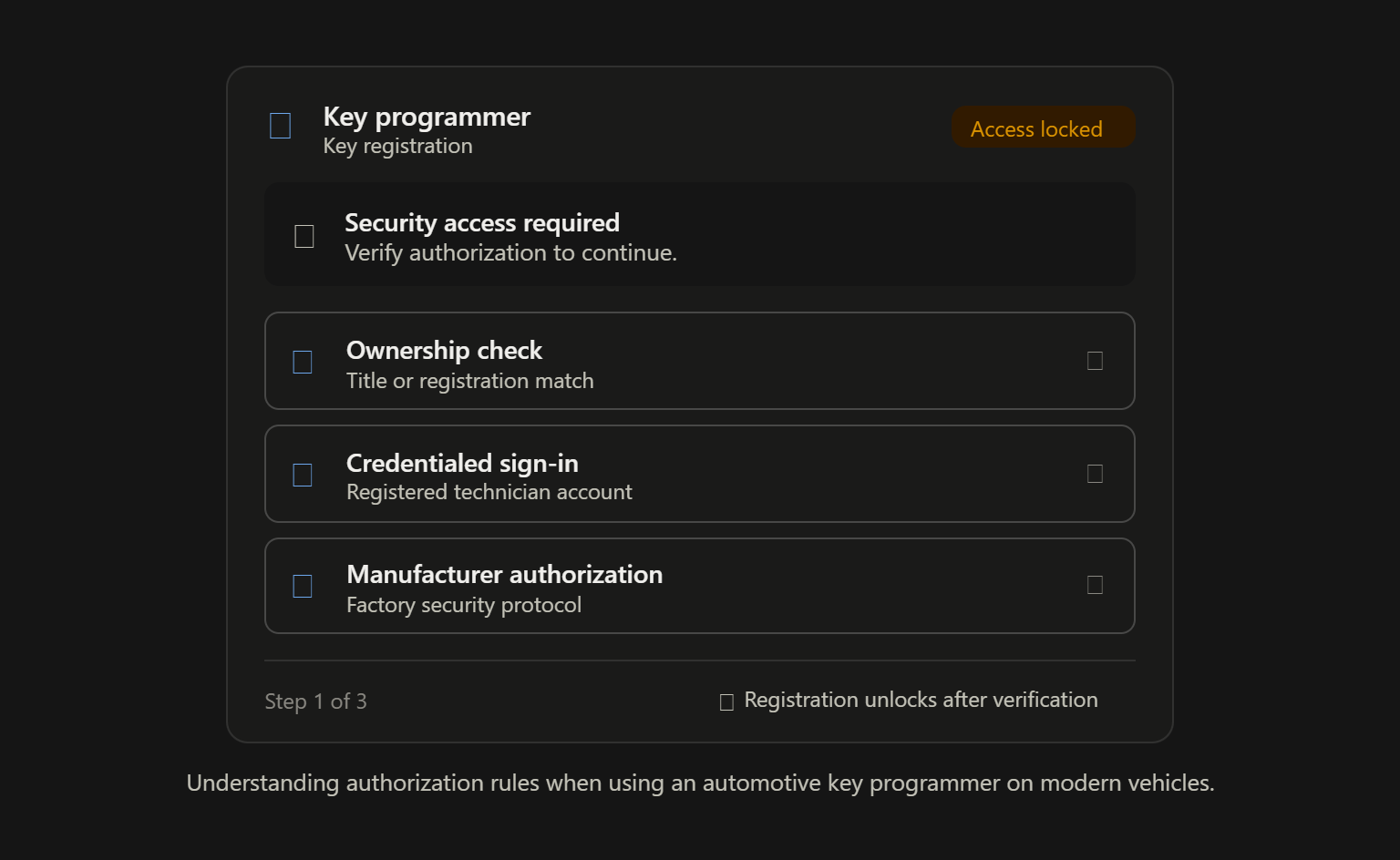
You should also be ready to demonstrate that you own the vehicle or have permission to arrange the work. A responsible service provider may request identification and registration or other ownership documents before cutting or programming a key. This protects the vehicle owner and helps prevent unauthorized access.
Ask for a clear quote before approving the job. Confirm whether the price includes the replacement key, mechanical cutting, electronic programming, remote functions, and testing. If the technician discovers a faulty module or antenna, ask for the diagnosis and additional cost before authorizing further repairs.
Security and Authorization: Why Professional Procedures Matter
An automotive key programmer is not simply another convenience accessory. It interacts with a vehicle’s anti-theft system, which is designed to prevent unauthorized starting. For that reason, some manufacturers restrict access to security codes, immobilizer functions, and key-registration procedures.
In the United States, the National Automotive Service Task Force operates authorized security credentialing procedures for qualified automotive professionals who need access to participating manufacturers’ security information. Its Vehicle Security Professional program verifies technicians and supports controlled access to services such as key programming and immobilizer work, ensuring that security operations require strict verification of vehicle ownership and proper transaction documentation.
These requirements are not universal worldwide. They depend on the country, manufacturer, vehicle, and type of service. If you are outside the United States or Canada, check the applicable local requirements and the vehicle manufacturer’s authorized service process rather than assuming that a US credentialing system applies to you.
For vehicle owners, the practical recommendation is to use a service provider who checks authorization before performing security-related work. Avoid anyone offering to bypass an immobilizer or work around ownership checks, staying informed through verified legal policy commentary on consumer protections and property standards. A legitimate replacement-key service should be able to explain what it will do, what documentation it needs, and how it will confirm that the finished key works correctly.
Common Mistakes That Can Waste Money
One costly mistake is buying a programmer based on brand compatibility alone. A product may support several vehicles from a manufacturer without supporting every model, year, or key type. Always confirm the exact function you need before purchasing.
Another mistake is assuming that a cut key is a programmed key. The blade may turn the lock while the electronic chip remains unrecognized. Before ordering a replacement, establish whether the problem is mechanical, electronic, or both.
Some owners replace the key fob repeatedly without checking the vehicle. If two keys behave in the same way, the fault may be with the vehicle’s antenna, immobilizer, wiring, or power supply. Replacing another key without diagnosis may simply repeat the expense.
It is also unwise to interrupt a programming operation or ignore the equipment manufacturer’s instructions. Some procedures depend on stable vehicle voltage and uninterrupted communication. If a tool reports a failure, record the message and seek guidance rather than repeatedly attempting unfamiliar operations.
Finally, do not assume that the cheapest automotive key programmer is the best value. Consider software updates, supported functions, technical assistance, accessories, and the cost of maintaining the device. A tool that cannot support the vehicles you work on is not a bargain, even if its initial price is low.
How to Know Whether You Need a Locksmith or a Dealership
Both automotive locksmiths and dealerships can provide replacement-key services, but the best choice depends on the vehicle and the nature of the problem.
An automotive locksmith may be a practical option when you need a spare key, a replacement fob, or help after losing your only key. Look for a provider who regularly works with your vehicle brand and can explain whether the job involves cutting, transponder registration, remote pairing, or a more complex immobilizer procedure.
A dealership may be preferable when the vehicle requires manufacturer-specific equipment, restricted security access, or a repair involving a control module. It can also be a suitable choice when the key problem is part of a wider warranty or electronic-system issue. Some independent locksmiths have advanced equipment and authorized access as well, so the decision should be based on capability rather than business type alone.
Before choosing, ask whether the provider has confirmed compatibility with your exact vehicle. Find out whether the replacement key is new, refurbished, or an approved reusable type, and whether all relevant functions will be tested. If the problem may involve a vehicle module, request a diagnosis before agreeing to replace expensive components.
What Does Automotive Key Programming Cost?
There is no single price for automotive key programming because the total cost depends on several factors. The vehicle’s make and model, the type of key, the availability of an existing working key, and the complexity of its immobilizer system can all influence the price.
A basic replacement key may involve a relatively straightforward cutting and programming service. A proximity smart key can cost more because the electronic unit itself may be more expensive and the registration process may be more involved. An all-keys-lost situation can also require additional work compared with adding a spare when a working key is available.
The service provider’s equipment and access requirements may affect the quote too. Some vehicles need manufacturer-specific security authorization or additional diagnostic work. If a fault is caused by a damaged antenna, wiring, or control module rather than the key, the repair may cost more than a standard programming job.
When comparing quotes, make sure you are comparing the same service. One price may include only programming, while another includes the key, cutting, remote setup, and final testing. Ask for the total cost and any possible additional charges before work begins. This makes it easier to judge whether the service is reasonably priced.
Best Practices for Maintaining Your Car Keys
Once the replacement key works, a few sensible habits can reduce the chance of another emergency. Keep a spare key in a secure location rather than waiting until the only working key is lost. If you have several keys, label them discreetly so you can identify which one has a problem without exposing vehicle details to strangers.
Protect electronic keys from water, impact, and unnecessary heat. A damaged casing can allow moisture to reach the circuit board, while repeated drops can damage internal connections. If the remote becomes unreliable, check its battery and physical condition before assuming the immobilizer needs reprogramming.
Pay attention to early warning signs. Intermittent key detection, inconsistent remote operation, or a security warning may indicate a developing problem. If the issue returns with a spare key, have the vehicle checked instead of replacing both keys without a diagnosis.
Keep replacement-key paperwork and service records in a safe place. If a key is lost or stolen, tell the service provider so they can determine whether the vehicle supports deleting the missing key. This is particularly important when the lost key may still provide access to the vehicle.
Final Recommendation: Choose the Programmer Around the Vehicle, Not the Advertisement
An automotive key programmer can be a valuable tool for qualified technicians and automotive locksmiths. It can support replacement-key registration, transponder learning, remote pairing, and selected immobilizer services. However, its usefulness depends on exact vehicle compatibility, current software, available security authorization, and the technician’s understanding of the vehicle’s electronic systems.
If you are a vehicle owner dealing with a lost or non-working key, start by identifying the symptoms and confirming whether the problem is mechanical, electronic, or vehicle-related. Then ask a qualified provider to verify the correct replacement key and programming method. If you are buying equipment for professional work, review the manufacturer’s coverage list and update policy before spending money.
The right automotive key programmer is not necessarily the one with the most features. It is the one that supports the vehicles and operations you actually need, has reliable technical support, and can be used through an appropriate, authorized process. Taking time to check these details can help you avoid unnecessary purchases, repeated programming attempts, and preventable security problems.
Frequently Asked Questions
1. Can an automotive key programmer program any car key?
No. An automotive key programmer supports only specific vehicle makes, models, years, and key systems. Some devices handle older transponder keys but have limited support for newer proximity smart keys. Always check the manufacturer’s current compatibility list and confirm that the exact programming function is supported.
2. Can I program a car key without the original key?
Sometimes, but it depends on the vehicle. Certain models support an authorized all-keys-lost procedure, while others require manufacturer security access, specialist equipment, or dealership assistance. Losing every key generally makes the job more complicated than adding a spare when one working key is available.
3. Does an OBD-II scanner program car keys?
A standard OBD-II scanner generally reads diagnostic trouble codes and vehicle data. It does not automatically include immobilizer or key-registration functions. Some advanced diagnostic platforms combine scanning and key programming, but you must verify that the specific device supports the required operation for your vehicle.
4. What is the difference between a key programmer and a key cutting machine?
A key cutting machine shapes the physical blade so it fits the vehicle’s mechanical lock. An automotive key programmer registers or synchronizes the electronic key credential with the vehicle’s security system. Some professional businesses offer both services, but the equipment and processes are different.
5. Why does my car key unlock the doors but not start the engine?
The remote-locking system and engine immobilizer may operate separately. The remote buttons might work while the transponder or smart-key credential is damaged, missing, or not recognized. A vehicle-side issue can cause similar symptoms, so have the key and immobilizer system checked before buying another fob.
6. Do I need a professional to use an automotive key programmer?
For most vehicle owners, professional service is the sensible option. Key programming can involve security authorization and vehicle-specific procedures. Professional technicians are better positioned to check compatibility, diagnose related faults, and confirm that the replacement key works correctly. Advanced programming equipment is intended for users with suitable training and authorized access.
7. Should I delete a lost key from my vehicle?
If a key has been lost or stolen, ask a qualified technician whether your vehicle supports removing that key from its accepted-key list. Deleting it may prevent the missing electronic key from starting the vehicle, depending on the system. Ask the technician to explain what functions will be disabled and whether the vehicle’s remaining keys will need any additional work.