

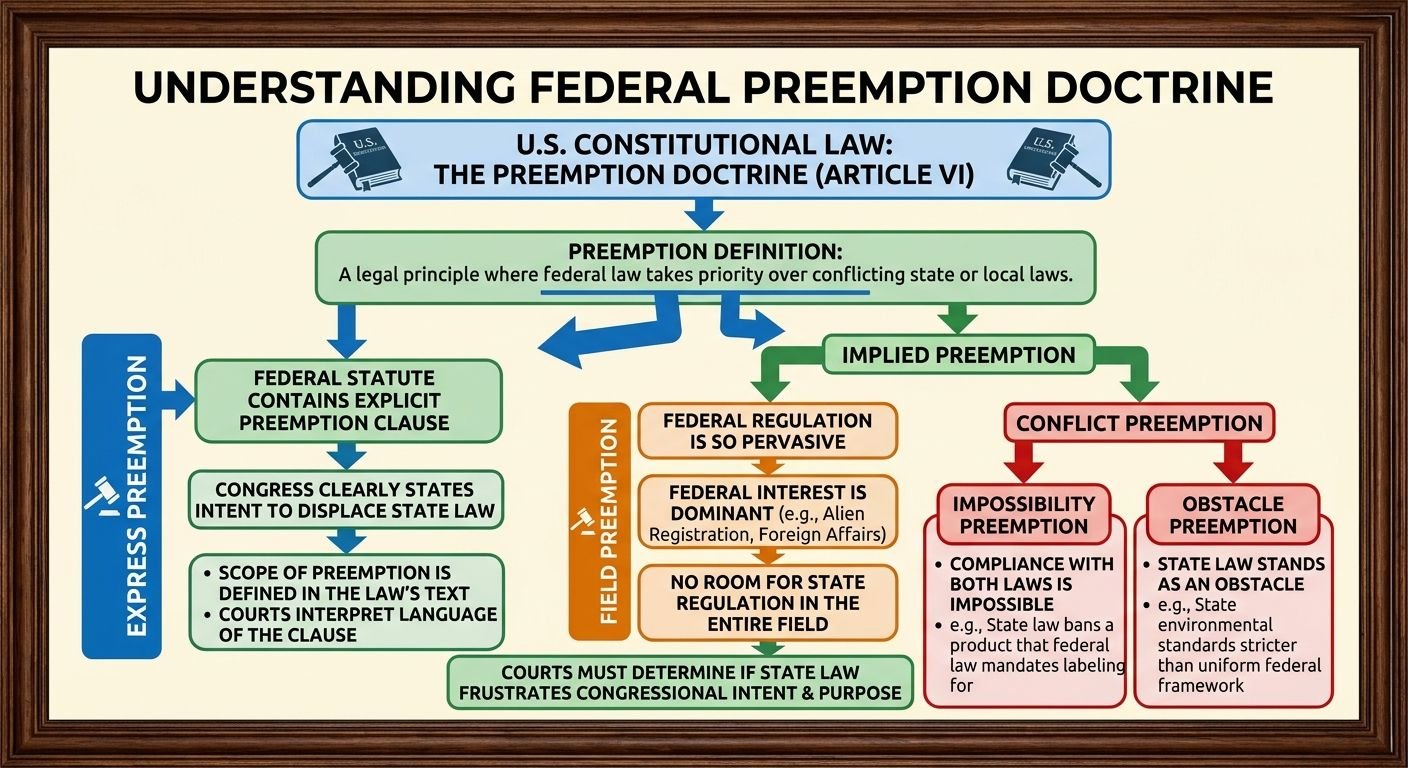
The preemption definition describes a legal principle in which one law, rule, or authority takes priority over another that would otherwise apply. In the United States, the term is most commonly used when federal law overrides a state or local law because the Constitution or a valid federal statute gives federal law controlling authority in that situation.
The idea becomes important when different levels of government establish rules about the same subject. For example, Congress may pass a federal law regulating a particular industry, while a state government creates its own requirements for businesses operating within its borders. If the federal government has legally displaced state authority in that area, the state rule may no longer be enforceable to the extent that it is preempted.
However, the preemption definition does not mean that federal law automatically cancels every state law covering the same subject. The two sets of rules may operate together when they are compatible and Congress has not intended to exclude additional state regulation. Courts must examine the relevant legislation, constitutional authority, and purpose before deciding whether preemption applies.
For ordinary readers, the easiest way to understand this principle is to think about competing legal requirements. If two authorities establish rules that cannot legally operate together, the law with controlling authority may take priority. The difficult part is determining whether a genuine legal conflict exists and how far that priority extends.
This distinction matters in everyday situations involving consumer protection, employment, transportation, environmental regulation, healthcare, product safety, and business operations. A company may believe that following a federal regulation is enough, only to discover that additional state requirements also apply. In another situation, a state may attempt to enforce a requirement that federal law has already displaced.
Understanding the preemption definition helps people recognize why these disagreements happen and why courts sometimes prevent a government from enforcing a particular regulation.
Why Does Legal Preemption Exist?
The United States has a federal system of government. This means governmental authority is divided between the national government and individual states. Both levels have responsibilities, although their powers come from different constitutional sources.
Congress has authority to legislate on subjects granted to it by the Constitution. States retain substantial powers over matters that fall within their authority, including many areas traditionally connected to public health, safety, welfare, and local government.
Problems can arise when both levels of government regulate the same activity. Sometimes their requirements support each other. In other situations, they establish different standards, create conflicting responsibilities, or pursue policy goals that cannot reasonably operate together.
The legal principle of preemption helps determine which rules remain enforceable when federal and state authority overlap.
The constitutional foundation for federal preemption rests on the Supremacy Clause framework established in Article VI, Clause 2 of the U.S. Constitution. This principle ensures that valid federal laws and treaties operate as controlling authority over state laws whenever direct regulatory conflicts arise.
Consider a hypothetical situation involving transportation safety. Congress establishes a nationwide requirement for a particular category of commercial vehicles. A state later creates a separate requirement that directly conflicts with the federal standard. If the federal law validly preempts that state requirement, the state cannot continue enforcing the conflicting rule.
However, the result may be different if the state requirement adds a compatible safety measure and the federal government has not excluded supplementary state regulation. The preemption definition therefore requires an examination of legal authority and legislative intent rather than a simple comparison of two rules.
The Main Types of Legal Preemption
Not every preemption dispute follows the same legal path. Courts generally recognize express preemption and implied preemption as the two main categories of federal preemption. Implied preemption includes field preemption and conflict preemption. Understanding these distinctions helps explain why one state law may remain valid while another is displaced.
Express Preemption: When Federal Law Clearly States Its Authority
Express preemption occurs when Congress includes language in a federal statute that specifically identifies state laws or requirements that federal law is intended to displace.
This type of preemption is generally easier to identify because lawmakers have included an explicit provision explaining the intended relationship between federal and state authority. However, determining the exact reach of that provision can still require careful legal interpretation.
For example, imagine Congress passes a law regulating certain safety standards for a nationally distributed product. The statute contains a provision stating that states cannot establish different requirements within a specified area. A state later adopts its own standard that falls within the provision’s scope.
A court examining the dispute would need to interpret the federal statute and determine whether the state requirement is covered by the express preemption language. The answer may depend on the wording of the provision, the type of state requirement involved, and any exceptions included in the legislation.
This is an important part of the preemption definition because it shows that federal lawmakers can directly address conflicts before they arise.
However, an express preemption clause does not necessarily invalidate every state regulation connected to the subject. Some statutes preserve particular state powers or allow additional requirements under specific circumstances. A court must examine the entire statutory framework rather than focusing on one sentence in isolation.
Implied Preemption: When Federal Intent Comes From the Law Itself
Implied preemption occurs when federal legislation does not expressly state that state law must yield, but its structure, purpose, and operation indicate that Congress intended federal authority to displace certain state requirements.
This category requires a closer examination of the legal framework. Courts consider the language of the federal law, its overall regulatory design, and the objectives Congress intended to achieve.
Implied preemption is particularly important because a statute does not need an express preemption clause to have a preemptive effect. Nevertheless, the existence of federal regulation alone does not automatically establish that state authority has been displaced.
There are two major forms of implied preemption: field preemption and conflict preemption.
Field Preemption: When Federal Law Occupies an Entire Regulatory Area
Field preemption occurs when federal regulation is so comprehensive, or the federal interest is sufficiently dominant, that courts determine Congress intended to leave no room for additional state regulation in the relevant field.
In this situation, a state law may be preempted even if it does not directly contradict a particular federal requirement. The issue is whether the federal government intended to control the entire regulatory area rather than allow individual states to establish supplementary rules.
For example, imagine Congress creates a detailed federal regulatory system governing a particular area of national activity. A state then introduces a separate regulatory framework covering the same field. Even if the state requirements appear compatible with federal rules, they may be displaced if Congress intended federal regulation to occupy the entire area.
Field preemption is not established simply because federal legislation contains many detailed provisions. Courts must examine whether Congress intended to exclude supplementary state regulation.
This distinction is useful when evaluating the preemption definition because it explains why some state requirements may be invalid even without a direct contradiction between the two laws.
Conflict Preemption: When Two Legal Requirements Cannot Work Together
Conflict preemption occurs when a state law interferes with federal law in a way that makes the two requirements legally incompatible.
There are two commonly recognized forms of conflict preemption. The first is impossibility preemption, and the second is obstacle preemption.
Impossibility preemption applies when a person or organization cannot comply with both federal and state requirements at the same time. For example, imagine a federal regulation requires a business to follow one specific procedure, while a state law requires that same business to follow an incompatible procedure. If complying with one necessarily means violating the other, a court may find that the state requirement is preempted.
Obstacle preemption is different. It may apply even when complying with both laws is technically possible. The question is whether the state requirement creates an obstacle to achieving the full purposes and objectives of federal legislation.
For instance, Congress may establish a federal program designed to create a consistent national approach to a particular issue. A state could introduce a requirement that interferes with the operation of that program, even if direct compliance with both rules is possible.
Courts examine the federal law as a whole when evaluating these disputes. They consider the statutory language, regulatory framework, and objectives rather than relying only on whether the two rules contain different wording.
The preemption definition becomes especially relevant in conflict cases because the legal issue is not simply which government created a rule first. It is whether the state requirement can operate consistently with valid federal authority.
Legal Information Institute+2
How Courts Determine Whether Preemption Applies
A preemption dispute usually requires a detailed legal analysis. Courts do not simply assume that a federal rule takes priority whenever a state adopts a different policy.
The first important consideration is the source of federal authority. A court examines whether Congress had constitutional authority to enact the relevant legislation and whether an agency regulation was issued within authority delegated by Congress.
Next, judges examine the actual language of the federal statute. If it contains an express preemption provision, its wording becomes a central part of the analysis. The court must determine which state laws are covered and whether any exceptions preserve state authority.
When the statute does not contain an explicit provision, the court considers whether preemption can be inferred from its structure and purpose. This includes evaluating whether Congress intended to occupy the entire field or whether a particular state requirement conflicts with federal objectives.
Another important consideration is the nature of the state law. A state requirement may be compatible with federal regulation, impose an additional obligation, create an impossible compliance situation, or interfere with the operation of a federal program. Each possibility requires a different legal assessment.
Courts may also consider whether Congress included a savings clause. A savings clause is a provision that preserves certain legal rights, claims, or state requirements that might otherwise be displaced. Its wording can significantly affect the scope of preemption.
For example, a federal statute may establish nationwide product standards while preserving certain state-law claims. In that situation, a manufacturer cannot assume that federal regulation automatically eliminates every possible state lawsuit.
The preemption definition therefore needs to be understood in the context of the specific law involved. General principles help explain the doctrine, but the actual result depends on the applicable statute and judicial interpretation.
Every CRS Report+2
Real-World Areas Where Preemption Can Affect People and Businesses
Legal preemption is not limited to constitutional discussions or disputes between government officials. It can affect businesses, consumers, employees, property owners, and individuals involved in legal proceedings.
Product Safety and Consumer Protection
Product safety is one area where federal and state requirements may overlap. Federal agencies can establish standards for products within their regulatory authority, while states may have separate consumer protection and safety laws.
A manufacturer selling products across the country may need to understand whether federal standards establish minimum requirements, whether additional state requirements are permitted, and whether a particular federal statute expressly displaces state law.
The answer can affect product labeling, manufacturing procedures, marketing practices, and potential legal claims.
For example, a company might satisfy a federal labeling requirement but face a state-law claim involving a different issue. Whether federal law preempts that claim depends on the governing statute and the nature of the legal requirement.
Environmental Regulations
Environmental regulation can involve federal, state, and local authorities. Federal legislation may establish nationwide standards, while states introduce additional environmental protections within their legal authority.
A business operating in several states may encounter different permitting procedures, reporting requirements, or environmental restrictions. The existence of federal regulation does not automatically prevent states from imposing additional obligations.
However, a state requirement may be preempted if federal law expressly excludes it or if the relevant legal framework creates a recognized form of implied preemption.
Understanding the preemption definition helps businesses avoid assuming that one federal approval automatically satisfies every state requirement.
Transportation and Aviation
Transportation often involves activities that cross state boundaries. Federal regulation can provide consistency in areas where different state rules could interfere with a national system.
Aviation is one example. Federal authorities have extensive responsibilities concerning aviation safety and related matters. Disputes may arise when state or local rules affect areas governed by federal regulatory authority.
However, the exact result depends on the subject of the state regulation and the scope of federal law. Not every local rule affecting an airport or airline is automatically preempted.
Employment and Workplace Requirements
Employment law also involves overlapping federal and state responsibilities. Federal statutes establish requirements concerning subjects such as workplace discrimination, wages, and employee protections, while states may provide additional protections.
In many circumstances, federal and state requirements operate together. For example, a state may establish a higher minimum wage than the federal minimum wage without necessarily creating a conflict.
This demonstrates why the preemption definition should not be interpreted as meaning that federal law always eliminates stronger state protections. The relevant federal statute must be examined to determine whether additional state requirements are permitted.
Healthcare and Insurance
Healthcare regulation involves several layers of government authority. Federal legislation may establish nationwide rules, while states regulate certain professional activities, insurance matters, and other healthcare-related issues.
Preemption disputes can arise when state requirements affect federally regulated programs or entities. For instance, a state rule may conflict with a federal statutory framework governing a particular insurance arrangement.
These disputes can be complicated because different federal statutes may establish different rules for different healthcare activities. A legal conclusion should therefore be based on the specific program and statutory provisions involved.
What Should You Do When You Suspect a Law Has Been Preempted?
Finding two different legal requirements does not automatically mean that one of them is invalid. If you are a business owner, employee, consumer, or someone involved in a legal dispute, you need to identify the actual legal issue before deciding how to respond.
Start by locating the exact federal and state provisions involved. General descriptions of a regulation are not enough. Read the actual statutory language, including definitions, exceptions, enforcement provisions, and any section addressing the relationship between federal and state law.
Next, determine whether the federal statute contains an express preemption clause. If it does, examine which state requirements the clause covers. Pay attention to wording such as requirements that are different from or additional to federal standards. These terms can have specific legal consequences depending on the statute.
If there is no express provision, consider whether the situation raises field or conflict preemption. Ask whether Congress intended federal law to occupy the entire regulatory area, whether complying with both laws is genuinely impossible, or whether the state requirement interferes with the objectives of federal legislation.
It is also important to check whether a savings clause or another exception preserves certain state requirements. Overlooking these provisions can lead to an incorrect conclusion about which law applies.
For businesses, reviewing applicable requirements before introducing a product, changing workplace procedures, or expanding into another state can prevent avoidable compliance problems. A company should not assume that meeting one federal standard automatically removes every state obligation.
If the disagreement could result in penalties, litigation, or significant financial consequences, consulting an attorney who understands the relevant area of law is a sensible step. Legal professionals can evaluate the applicable statutes, regulations, court decisions, and facts before recommending a course of action.
The most practical approach is to treat the preemption definition as a starting point when evaluating broader legal principles and statutory rules, rather than viewing it as an automatic answer to every conflict between government regulations.
Common Mistakes People Make When Understanding Preemption
One frequent mistake is assuming that federal law always wins whenever it differs from state law. Although the Supremacy Clause establishes the priority of valid federal law in cases of conflict, federal authority must still rest on a proper constitutional and statutory foundation.
Another mistake is treating every difference between two laws as a direct conflict. State and federal regulations can address the same subject while imposing compatible obligations. For example, a federal rule may establish a minimum safety standard while state law requires additional precautions. Whether those additional requirements are allowed depends on the relevant federal framework.
People also confuse express preemption with implied preemption. Express preemption involves specific statutory language displacing state requirements, while implied preemption depends on the structure, purpose, and operation of federal law.
A further mistake is overlooking the difference between field preemption and conflict preemption. Field preemption concerns Congress’s intention to occupy an entire regulatory area. Conflict preemption focuses on whether state law makes compliance impossible or obstructs federal objectives.
Some businesses also assume that a federal agency can automatically invalidate any state regulation covering the same industry. In reality, an agency’s preemptive authority depends on the authority delegated by Congress and the relevant legal framework.
Finally, people sometimes rely on outdated summaries or general online explanations instead of reviewing the actual law. Preemption decisions can depend on small differences in statutory wording, so using a general definition without examining the specific legal provision can create serious misunderstandings.
Important Court Decisions That Help Explain Federal Preemption
Court decisions have played an important role in developing the modern understanding of federal preemption. They help explain how the Supremacy Clause operates when federal and state governments establish different legal requirements.
In Hines v. Davidowitz (1941), the Supreme Court examined a Pennsylvania law requiring certain foreign nationals to register with the state alongside a federal registration system. The Court concluded that the state law interfered with the federal system and was preempted. The decision remains important in discussions about conflict preemption and federal objectives.
In Arizona v. United States (2012), the Supreme Court considered several provisions of an Arizona immigration law. The Court concluded that certain provisions were preempted because federal immigration law occupied the relevant field or because the state provisions conflicted with the federal framework. The decision demonstrates that a state cannot independently establish requirements that undermine an area of federal regulation intended to operate nationally.
Another important case is Wyeth v. Levine (2009), which involved federal drug labeling requirements and a state-law failure-to-warn claim. The Supreme Court rejected the manufacturer’s argument that federal law automatically preempted the claim. The decision illustrates why compliance with federal regulation does not necessarily eliminate all state-law responsibilities.
These decisions show that preemption is not a simple rule that applies identically to every dispute. Courts examine the particular federal statute, the state requirement, congressional intent, and the practical relationship between the two legal systems.
Every CRS Report+2
Why Understanding Preemption Matters for Future Legal and Business Decisions
Government regulation continues to change as new industries develop and existing activities become more complex. Technology, online services, artificial intelligence, consumer privacy, financial services, and environmental protection can all raise questions about which government authority has the power to establish controlling requirements.
These developments make the preemption definition particularly relevant for organizations operating across multiple states. A business may need to follow federal requirements while also complying with state regulations that remain legally valid.
The issue is especially important when Congress creates a nationwide regulatory framework. Lawmakers may want consistent national standards, but they may also preserve room for states to address local concerns. The wording and purpose of the legislation determine how those responsibilities interact.
Courts will continue to play an important role in resolving disagreements about the boundaries of federal and state authority. Their decisions can affect how companies operate, how governments enforce regulations, and what legal protections individuals can rely on.
For anyone studying law or dealing with regulatory responsibilities, the best approach is to understand the specific legal framework rather than relying on the assumption that one level of government always controls. Careful interpretation helps identify which requirements remain enforceable and where additional legal guidance may be necessary.
Conclusion
The preemption definition explains how one law can take priority over another when the legal system gives it controlling authority. In the United States, federal preemption is primarily based on the Supremacy Clause of the Constitution, which establishes the priority of valid federal law over conflicting state requirements.
However, preemption does not automatically eliminate every state law that addresses a federally regulated subject. Express preemption, field preemption, and conflict preemption each involve different legal considerations. Courts examine statutory language, congressional intent, regulatory objectives, and the practical relationship between the laws involved.
For individuals and businesses, understanding this principle can make it easier to evaluate regulatory responsibilities, recognize potential legal conflicts, and avoid incorrect assumptions about government authority. The most important lesson is that determining whether a law has been preempted requires examining the specific legal provisions and circumstances rather than relying on a general rule.
Frequently Asked Questions About the Preemption Definition
1. What is the preemption definition in simple terms?
The preemption definition refers to a legal principle in which one law takes priority over another law that would otherwise apply. In the United States, it commonly describes situations where valid federal law overrides conflicting state or local requirements.
2. What is an example of preemption?
An example occurs when Congress establishes a federal requirement that prevents states from enforcing different standards in a particular regulatory area. If a state introduces a conflicting requirement covered by the federal preemption provision, that state requirement may become unenforceable.
3. What are the four main types of preemption?
The main categories commonly discussed in federal preemption law are express preemption, implied preemption, field preemption, and conflict preemption. Express and implied preemption are the two broad categories, while field and conflict preemption are forms of implied preemption.
4. What is the difference between preemption and supremacy?
The Supremacy Clause is the constitutional provision establishing the priority of valid federal law over conflicting state law. Preemption is the legal doctrine used to determine when federal law displaces state requirements under that constitutional principle.
5. Can state laws override federal laws?
Generally, states cannot enforce laws that conflict with valid federal law when federal law preempts them. However, states retain authority over many matters, and federal legislation does not automatically displace every state regulation addressing the same subject.
6. Does preemption apply only to federal and state laws?
No. Although federal preemption is the most common use of the term in U.S. constitutional law, preemption can also describe situations involving state and local authority or other legal rules that displace competing requirements.
7. Who decides whether a state law is preempted?
Courts determine whether a particular state requirement is preempted when a legal dispute properly comes before them. They examine the relevant federal statute, constitutional authority, legislative intent, applicable regulations, and the circumstances of the case.