
When a country enters an armed conflict, the consequences reach far beyond the soldiers fighting on the battlefield. Civilians may lose their homes, medical facilities can come under pressure, families may become separated, and captured soldiers may face uncertain conditions. This raises an important question: are there international rules that prevent people from being treated without basic humanity during war? The Geneva Convention provides an essential part of that protection.
The Geneva Convention is often mentioned in news reports, political discussions, military operations, and international legal cases. However, many people are unsure about what these agreements actually require, who they protect, and whether they apply to every type of armed conflict. Some believe they prohibit war entirely, while others assume that their rules apply only to soldiers. Both assumptions overlook important parts of international humanitarian law.
Understanding these agreements helps readers recognize the difference between lawful military operations and prohibited conduct. It also explains why civilians, medical workers, prisoners of war, and wounded combatants receive special protection even when fighting continues.
This guide explains the history, four main treaties, legal protections, responsibilities of conflicting parties, enforcement challenges, and practical consequences of violations. It also clarifies common misunderstandings so readers can better understand how these international rules work in real situations.
What Is the Geneva Convention and Why Was It Established?
The Geneva Convention refers to a group of international treaties that establish humanitarian rules for situations of armed conflict. Their central purpose is to reduce unnecessary suffering and protect people who are not participating in fighting or can no longer take part. These protections include civilians, wounded soldiers, medical personnel, prisoners of war, and people affected by military occupation.
The modern framework consists of four Geneva Conventions adopted in 1949. They form the foundation of international humanitarian law, also called the law of armed conflict or the law of war. Additional agreements, particularly the Additional Protocols of 1977 and 2005, expanded and clarified certain protections. These treaties do not make every military action illegal. Instead, they establish boundaries that parties must respect when an armed conflict takes place.
The need for these rules became particularly clear during the nineteenth century. In 1859, Swiss humanitarian Henry Dunant witnessed the suffering of wounded soldiers after the Battle of Solferino. He was deeply concerned that injured people were left without sufficient medical assistance and that organized systems for caring for battlefield casualties were inadequate.
His observations inspired proposals for neutral humanitarian assistance and organized relief societies. These ideas contributed to the first Geneva Convention, adopted on August 22, 1864. Its primary concern was improving the treatment of wounded soldiers on land and protecting those providing medical assistance.
Over time, warfare changed, and the original agreement could no longer address every humanitarian challenge. New treaties expanded protections to wounded military personnel at sea, prisoners of war, and civilians. Following the Second World War, the international community adopted four updated conventions on August 12, 1949. These agreements established the central legal framework that remains in force today.
One important point is that the Geneva Convention does not determine whether a country is justified in starting a war. That question belongs to a different area of international law known as jus ad bellum. International humanitarian law, or jus in bello, regulates how parties must behave once an armed conflict exists. This distinction matters because humanitarian protections apply regardless of which side claims to have the stronger political or military justification.
Understanding the Four Geneva Conventions
The four treaties adopted in 1949 address different groups of people affected by warfare. Understanding their individual purposes makes it easier to identify which protections apply in a particular situation.
First Geneva Convention: Protection of Wounded and Sick Soldiers on Land
The First Geneva Convention focuses on wounded and sick members of armed forces during land-based conflicts. Its purpose is to ensure that injured soldiers receive appropriate medical attention instead of being abandoned, attacked, or mistreated because they can no longer fight.
For example, imagine that a soldier is injured during a military operation and can no longer defend himself. Once that person is wounded and outside active participation in hostilities, the opposing force must respect the applicable humanitarian protections. Medical personnel must be allowed to provide care without being deliberately targeted.
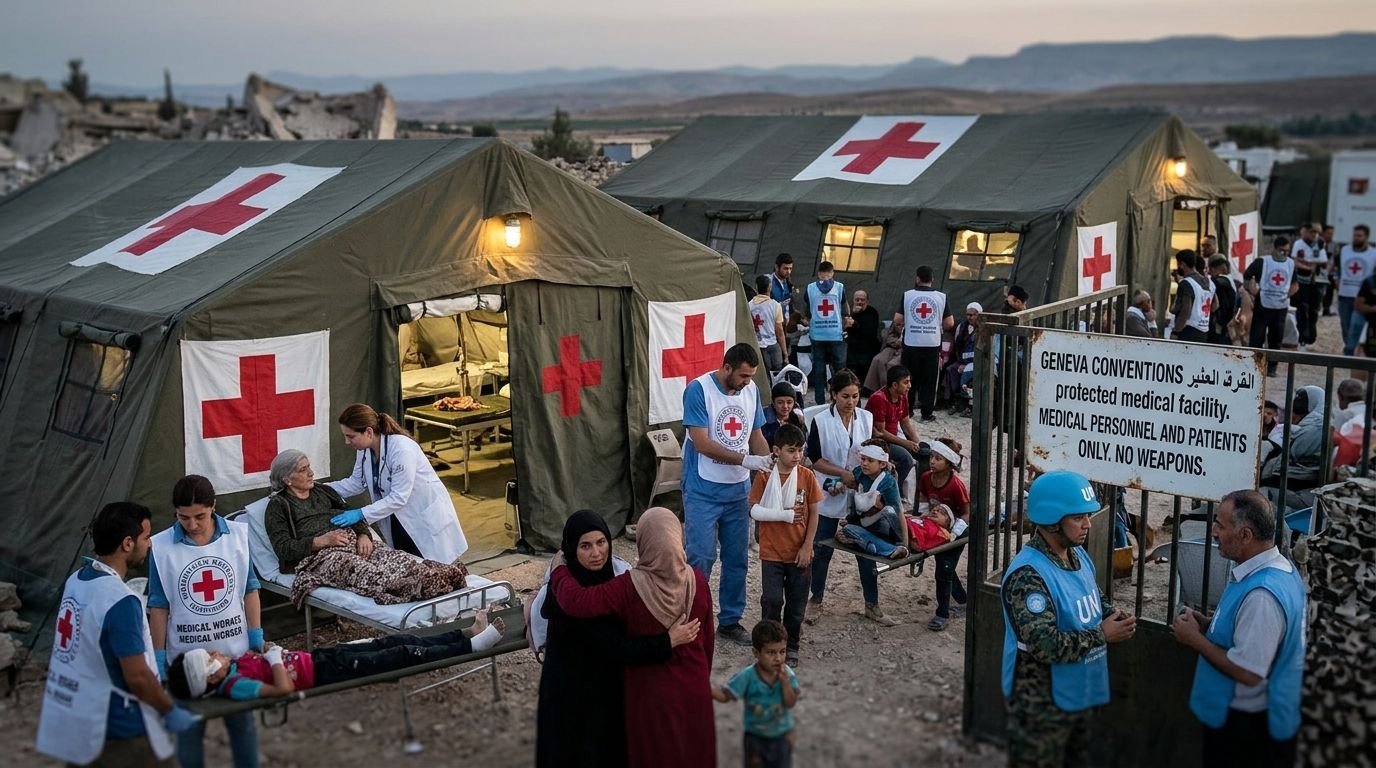
The agreement also protects military medical units, hospitals, ambulances, and authorized medical personnel. The red cross emblem identifies protected medical services, while the red crescent and red crystal are also recognized protective emblems under the relevant treaties.
A common misunderstanding is that medical protection disappears when medical workers treat injured members of the opposing army. That is not how the rules work. Medical personnel must provide care according to medical need without unlawful discrimination. Their humanitarian role does not make them legitimate military targets.
Second Geneva Convention: Protection of Wounded, Sick, and Shipwrecked Personnel at Sea
The Second Geneva Convention extends similar humanitarian principles to naval warfare. It protects wounded, sick, and shipwrecked members of armed forces at sea, including people who have become unable to participate in military operations.
Naval conflicts create different risks from land-based fighting. A damaged warship may leave military personnel stranded in dangerous waters, while injured crew members may need immediate rescue. The agreement requires parties to respect and protect eligible people who are no longer fighting.
Consider a situation in which a naval vessel is damaged during an engagement and several crew members enter the water. Their military background does not remove their right to humanitarian protection. Parties must take appropriate measures to collect and care for the wounded, sick, and shipwrecked, subject to the applicable rules and circumstances.
The agreement also protects medical ships and personnel performing humanitarian duties. This is important because rescue operations should not become additional opportunities to attack people who are already vulnerable.
Third Geneva Convention: Rights and Treatment of Prisoners of War
The Third Geneva Convention deals specifically with prisoners of war. It establishes detailed rules governing how captured combatants must be treated, what protections they receive, and what responsibilities the detaining authority must fulfill.
Capture does not mean that a soldier loses every legal protection. A prisoner of war must be treated humanely and protected against violence, intimidation, insults, and public curiosity. Torture and coercive treatment to obtain information are prohibited.
The detaining authority also has responsibilities concerning food, accommodation, medical treatment, and basic living conditions. Prisoners must receive adequate care based on the requirements of the applicable treaty. They must also have access to appropriate communication arrangements with their families and relevant humanitarian organizations.
For instance, if a soldier is captured during an international armed conflict, the detaining power cannot use that person’s vulnerable position as an excuse for physical abuse or humiliation. Questions about identity and status must be handled through appropriate legal procedures.
The agreement also regulates interrogation, work assignments, disciplinary measures, judicial proceedings, and release or repatriation. These protections are important because the treatment of prisoners should not depend on anger, revenge, or the political position of the capturing country.
International Committee of the Red Cross+1
Fourth Geneva Convention: Protection of Civilians During Armed Conflict
The Fourth Geneva Convention focuses on civilians who are affected by international armed conflicts and occupation. It recognizes that ordinary people should not become targets simply because they live in a country involved in war.
Civilians may face serious risks when military operations take place near residential areas. They may also experience displacement, detention, family separation, shortages of essential supplies, or restrictions on everyday activities. This treaty establishes protections intended to prevent mistreatment and reduce the humanitarian consequences of these situations.
For example, an occupying power cannot treat the civilian population as though it has unlimited authority over their lives. The agreement places restrictions on measures such as deportation, unlawful confinement, and other forms of mistreatment. It also addresses medical care, food supplies, family contact, and the treatment of protected persons.
The Fourth Geneva Convention is especially important in occupied territories because civilian protections do not disappear simply because control of an area changes. Occupation creates specific legal responsibilities for the occupying power.
However, it is important to understand that not every person affected by violence automatically receives the same legal status under every provision. The exact protections depend on the person’s circumstances, the type of conflict, and the relevant legal rules.
International Committee of the Red Cross+1
When Does the Geneva Convention Apply?
One of the most common questions concerns the circumstances in which these international agreements become legally applicable. Their protections are connected to the existence and classification of an armed conflict, not simply to political tension or disagreements between countries.
In an international armed conflict, the relevant rules generally apply when two or more states resort to armed force against one another, a reality often analyzed in modern assessments examining whether formal declarations are used in contemporary state clashes. An official declaration of war is not required.
Even a relatively limited confrontation between the armed forces of two states can trigger the applicable international humanitarian law.
A non-international armed conflict is different. It generally involves government forces fighting organized armed groups, or organized armed groups fighting one another. However, not every violent incident or internal disturbance qualifies. The situation must meet specific legal requirements concerning the intensity of violence and the organization of the armed groups involved.
Common Article 3, which appears in all four 1949 treaties, establishes minimum humanitarian protections for non-international armed conflicts. It prohibits acts such as murder, torture, cruel treatment, hostage-taking, and humiliating or degrading treatment of people who are not actively participating in hostilities or are no longer doing so.
Additional Protocol II provides further rules for certain non-international armed conflicts when its specific conditions are met. It is important not to assume that every treaty provision applies identically to every conflict. Legal classification determines which particular rules govern the situation.
Another important distinction is that ordinary riots, isolated acts of violence, and internal disturbances do not automatically qualify as armed conflicts. Such situations may be governed by domestic law and international human rights law rather than the full framework of international humanitarian law.
Seven Essential Protections Under the Geneva Convention
The practical value of the Geneva Convention becomes clearer when its protections are considered in everyday situations involving armed conflict. These rules are designed to establish minimum standards of humanity even when opposing forces are engaged in serious fighting.
Protection of Civilians
Civilians must not be deliberately targeted simply because they live in an area controlled by an opposing party. Parties to a conflict must distinguish between civilians and combatants and between civilian objects and military objectives. Direct attacks against civilians are prohibited.
This principle is particularly important during urban warfare, where military installations may exist close to homes, schools, and hospitals. The presence of military activity does not remove the obligation to protect civilians.
Humane Treatment of Prisoners
People held in custody must receive humane treatment. Physical abuse, torture, intimidation, and degrading treatment are prohibited under the applicable rules. Prisoners of war also receive specific protections concerning accommodation, food, medical attention, and communication.
Medical Assistance for the Wounded
Wounded and sick people must receive appropriate medical care without unlawful discrimination. Parties must respect medical personnel, authorized medical facilities, and protected medical transport.
Protection Against Torture
Torture and cruel treatment are prohibited. A person cannot lawfully be subjected to severe physical or mental suffering to obtain information, force a confession, or punish them for their association with an opposing party.
Respect for Humanitarian Medical Services
Medical workers and facilities performing protected humanitarian functions must not be deliberately attacked. Their role is to save lives and treat injured people, not to participate in military operations.
Protection of Families and Civilian Dignity
The rules recognize the importance of maintaining family contact, respecting personal dignity, and protecting civilians against certain forms of coercion, displacement, and mistreatment.
Restrictions on Military Operations
The broader framework of international humanitarian law restricts how attacks may be conducted. It requires distinction between military objectives and civilians, prohibits indiscriminate attacks, and establishes proportionality and precaution requirements. These rules are essential for reducing avoidable civilian harm.
ICRC+2
What Happens When a Party Violates the Geneva Convention?
Having international rules is important, but their effectiveness also depends on whether governments, military forces, and other parties follow them. Violations can cause serious harm to individuals and may create legal responsibility for those involved.
A serious violation of certain provisions of the Geneva Convention can constitute a grave breach. Depending on the circumstances and applicable treaty, examples include willful killing, torture, inhuman treatment, unlawful deportation, and extensive destruction or appropriation of property not justified by military necessity and carried out unlawfully.
These acts are not simply disagreements about military strategy. They can amount to serious international crimes. The legal consequences depend on the specific conduct, the applicable treaty, the status of the individuals involved, and the available evidence.
How Are Violations Investigated?
Investigating an alleged violation requires more than a photograph, social media post, or statement from one side of a conflict. Investigators need reliable evidence that helps establish what happened, who was responsible, and which legal rules applied.
Evidence may include witness statements, medical records, photographs, videos, satellite imagery, military documents, and physical evidence collected from the location. Investigators also examine the circumstances surrounding an incident, including whether a target was military or civilian and what information was available to those responsible for an operation.
International organizations may document humanitarian concerns, while national authorities and international investigative bodies may examine possible crimes within their respective legal powers. The International Committee of the Red Cross (ICRC) also has an important humanitarian role, including visiting certain detainees and communicating confidentially with authorities.
Can Individuals Be Held Personally Responsible?
Yes. International humanitarian law does not place responsibility only on governments. Individuals may also face criminal responsibility for serious violations, including war crimes.
Military commanders can potentially be held responsible when the legal requirements for command responsibility are met. This may involve situations in which commanders knew or should have known about crimes committed by subordinates and failed to take the necessary and reasonable measures to prevent or punish them.
The International Criminal Court may investigate and prosecute individuals for crimes within its jurisdiction, subject to the Rome Statute’s requirements. However, it does not automatically investigate every reported violation. Jurisdiction, admissibility, evidence, and other legal conditions matter.
It is also important to understand that the International Court of Justice and the International Criminal Court perform different functions. The former primarily handles disputes between states and certain advisory matters, while the latter prosecutes individuals accused of specified international crimes.
Why Is Enforcing International Humanitarian Law So Difficult?
Even when the applicable rules are clear, enforcement can be challenging during an active conflict. The difficulty often comes from limited access to affected areas, political disagreements, security restrictions, and the practical problems involved in gathering reliable evidence.
For example, investigators may be unable to enter a damaged city while fighting continues. Witnesses may have fled, buildings may have been destroyed, and important documents may be inaccessible. These conditions can delay investigations and make it harder to establish responsibility.
Political influence can create additional obstacles. Governments may reject accusations, restrict independent access, or disagree about the legal classification of an incident. International legal institutions also operate within defined jurisdictional and procedural limits.
Another challenge is that different parties may provide conflicting accounts of the same event. One side might describe an operation as a necessary military action, while another claims that civilians were deliberately targeted. Determining the truth requires independent examination rather than accepting either statement without verification.
This is why the Geneva Convention framework must be supported by practical implementation. Governments need appropriate military training, domestic legislation, investigation procedures, and systems for holding responsible individuals accountable.
The rules also cannot depend on whether one side follows them first. A violation by one party does not give the opposing party permission to commit the same violation. Humanitarian obligations remain binding regardless of retaliation or political disagreements.
Common Misunderstandings About the Geneva Convention
Many discussions about wartime conduct become confusing because people use legal terms without understanding their actual meaning. Clearing up these misunderstandings makes it easier to assess claims and avoid spreading inaccurate information.
One common misconception is that the Geneva Convention makes war illegal. In reality, it regulates conduct during armed conflict. Whether a state may legally use force is a separate question governed primarily by the United Nations Charter and other applicable international law.
Another misunderstanding is that only soldiers receive protection. The four treaties cover different categories of people, including wounded military personnel, prisoners of war, and civilians. Additional humanitarian rules also protect people who are not actively participating in hostilities during certain internal conflicts.
Some people believe that a country can ignore humanitarian rules if its opponent violates them first. This is incorrect. International humanitarian law does not generally operate on a system of retaliation in which one violation cancels the other side’s obligations.
There is also confusion about the red cross emblem. It is not simply a general symbol for any organization offering assistance. It is a protected emblem with a specific legal meaning. Its misuse can undermine the protection and trust associated with medical and humanitarian services.
Finally, not every alleged violation automatically proves that a war crime has occurred. A legal determination requires examination of the relevant facts, applicable law, and required elements of the alleged offense. Responsible reporting should distinguish between an allegation, an investigation, and an established legal finding.
How Can People Identify Reliable Information About Wartime Violations?
When a conflict receives international media attention, reports can spread quickly. Some contain verified information, while others may include incomplete footage, misleading captions, or claims that have not been independently confirmed.
Readers should first identify the original source of a report. An official statement, humanitarian organization, independent journalist, and social media account may provide different types of information. Understanding who produced the material helps readers assess its reliability.
It is also useful to check whether multiple credible sources independently confirm the same event. A video may show genuine destruction but fail to establish its date, location, cause, or the identity of those responsible. These details matter when evaluating a possible violation of international humanitarian law.
For legal questions, consulting the original treaty text alongside official ICRC commentaries provides far more dependable guidance than relying on brief online summaries. The distinction between international and non-international armed conflicts is particularly important because the applicable legal protections can differ.
Readers should also avoid treating every civilian casualty as automatic proof of an unlawful attack. Civilian deaths require serious investigation, but the legal assessment must consider the target, circumstances, expected military advantage, anticipated civilian harm, and precautions taken, as required by the applicable rules.
A careful approach helps prevent misinformation while keeping attention on the humanitarian concerns that deserve investigation.
Why the Geneva Convention Remains Important Today
Modern warfare has changed considerably since the original humanitarian agreements were developed. Armed conflicts may involve drones, cyber operations, advanced surveillance systems, urban combat, and military technologies that create new legal and practical questions.
However, technological change does not remove the fundamental obligation to protect people who are not participating in hostilities. Existing humanitarian principles remain relevant when evaluating the effects of new military methods and weapons.
For example, using advanced technology does not remove the requirement to distinguish between military objectives and civilian objects. Similarly, the use of automated systems does not eliminate the need to comply with applicable legal restrictions on attacks.
The Geneva Convention also remains relevant because armed conflicts frequently affect people who have little control over the decisions that cause them. Children, older people, displaced families, medical workers, and other vulnerable individuals may face serious consequences even when they have no involvement in military operations.
Its continued importance depends on practical respect for humanitarian rules. Governments must translate international commitments into national laws, provide appropriate military education, investigate alleged violations, and support humanitarian access where required.
The international community also needs accurate documentation and responsible public discussion. These efforts cannot prevent every violation, but they help preserve accountability and reinforce the principle that basic human dignity must not disappear during war.
Practical Ways to Understand and Apply These Rules
For readers studying international law, the most useful starting point is to identify the type of armed conflict being discussed. This helps determine which treaties and additional rules may apply. Without that first step, it is easy to misunderstand the legal position of civilians, captured combatants, or other affected individuals.
Next, identify the people involved. A wounded soldier, a prisoner of war, a civilian in occupied territory, and a medical worker may fall under different provisions. Their legal protections should be assessed according to their actual circumstances rather than assumptions about their nationality or political position.
It is equally important to distinguish between the four Geneva Conventions and their Additional Protocols. The 1949 treaties establish the central framework, while the later protocols expand and clarify particular protections. Not every state has the same treaty commitments regarding every additional protocol, although customary international humanitarian law also plays an important role.
When examining a possible violation, focus on verified facts. Establishing the location, timing, conduct, people affected, and available evidence is more useful than relying on emotional reactions or unverified claims.
Finally, consult reliable legal and humanitarian resources before reaching conclusions. The original treaty texts, ICRC commentaries, official government materials, and relevant court decisions can provide a much clearer understanding than general online discussions.
Conclusion
The Geneva Convention represents an important international effort to preserve human dignity during armed conflict. Its four treaties establish protections for wounded soldiers, shipwrecked military personnel, prisoners of war, and civilians affected by warfare. Additional protocols and customary international humanitarian law provide further rules for situations that the original agreements do not address in sufficient detail.
Understanding these protections requires more than memorizing treaty names. Readers need to recognize when the rules apply, which individuals receive protection, what conflicting parties must do, and how serious violations can be investigated. It is equally important to understand that humanitarian obligations do not disappear because an opposing force has broken the rules.
Ultimately, the purpose of the Geneva Convention is not to make armed conflict harmless. It is to establish legal boundaries that prevent unnecessary suffering and protect people who are especially vulnerable during war. Respecting those boundaries remains a responsibility of every party involved in an armed conflict.
Frequently Asked Questions About the Geneva Convention
1. What is the main purpose of the Geneva Convention?
The main purpose of the Geneva Convention is to establish humanitarian protections during armed conflicts. It protects people who are not participating in fighting or can no longer participate, including civilians, wounded soldiers, prisoners of war, and medical personnel. It also establishes responsibilities for parties involved in armed conflicts.
2. How many Geneva Conventions are there?
There are four Geneva Conventions, all adopted in 1949. Each addresses a different category of protection, including wounded soldiers on land, wounded and shipwrecked military personnel at sea, prisoners of war, and civilians affected by armed conflict.
3. Does the Geneva Convention apply to every country?
Yes. All 196 states have ratified the four Geneva Conventions of 1949. However, participation in additional treaties and protocols can differ between countries. Customary international humanitarian law also establishes important obligations that apply more broadly.
4. Can soldiers be punished for violating the Geneva Convention?
Yes. Individuals responsible for serious violations may face criminal prosecution when the legal requirements are satisfied. Depending on the circumstances, certain acts can constitute war crimes. National courts and international criminal institutions may have jurisdiction over relevant cases.
5. Does the Geneva Convention protect civilians during a civil war?
Yes. Common Article 3 provides minimum humanitarian protections in non-international armed conflicts, including certain civil wars. Additional Protocol II may provide further protections when its specific requirements are met. The precise legal framework depends on the nature and circumstances of the conflict.
6. Does the Geneva Convention prohibit the use of all weapons?
No. The Geneva Convention does not prohibit every weapon or military operation. However, international humanitarian law restricts weapons and methods of warfare that cause prohibited or unnecessary suffering or fail to comply with applicable rules. Other international treaties specifically regulate or prohibit particular weapons.