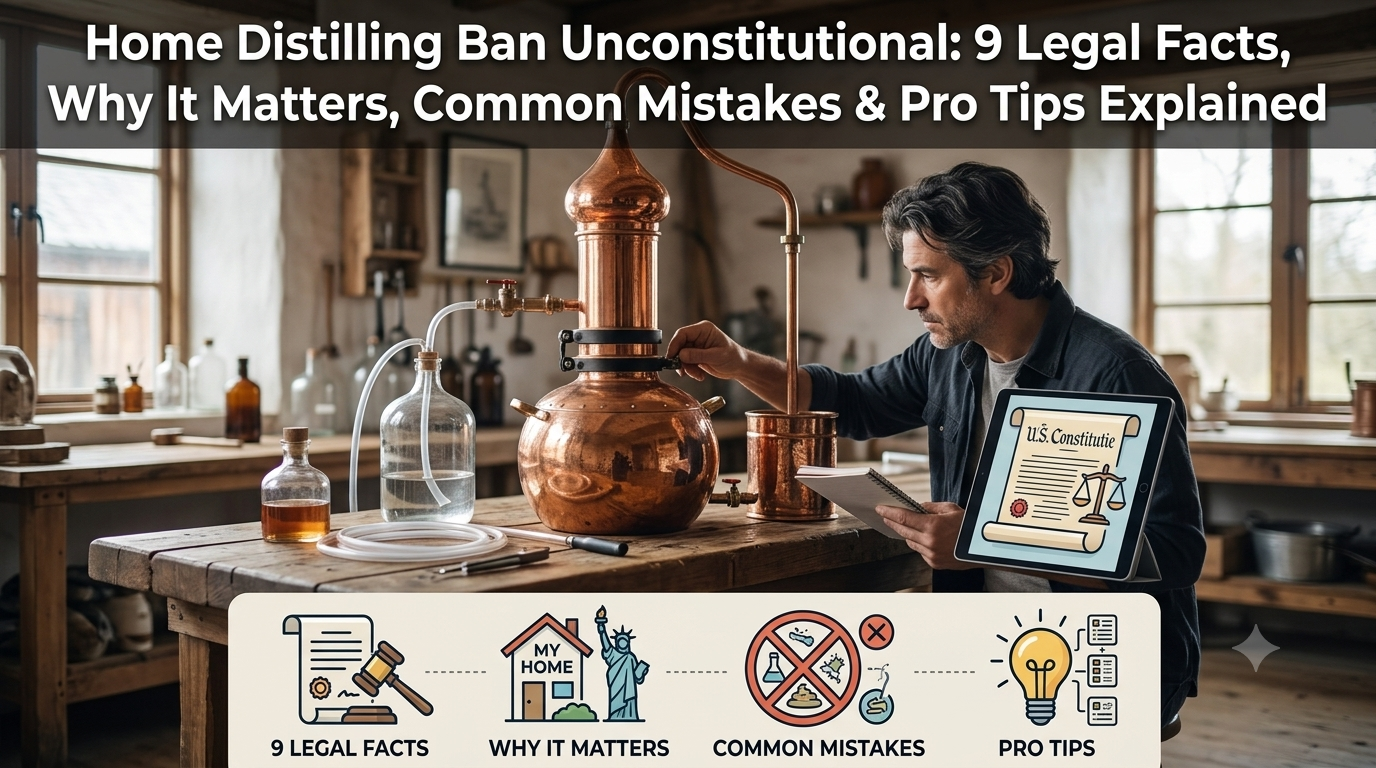
The phrase home distilling ban unconstitutional appears frequently in online discussions, legal forums, and conversations among hobbyists interested in producing distilled spirits at home. While the question may appear to be a simple “yes or no” matter, the question of home distilling in the United States has many complexities based on constitutional law, federal and state statutes, previous case decisions, and public safety concerns. The distinction must be drawn between an opinion about law and law that has been recognized. Some contend that constitutional barriers, such as the protections for personal liberty, private property, and equal protection under the law, protect the right to distill liquor for personal consumption.
In response, others indicate that American courts have long sustained broad legislative power to control the production and sale of alcoholic beverages in the form of taxation and public safety laws.
This guide is designed to take a neutral, informational look at the constitutional issue, examine the reasoning why this question is important to answer, evaluate the common misunderstandings of the legal standing, and analyze how courts usually rule in this area.
Why Distilling Ban Unconstitutional Matters
Questions surrounding whether a home distilling ban unconstitutional claim has legal merit extend beyond home alcohol production. They touch on broader constitutional principles about individual freedoms, government authority, taxation, commerce, and public health.
As the internet provides an increasing number of resources to anyone interested in the subject, we want to ensure readers understand where the debate truly lies. Often people who are researching the subject of alcohol distillation will discover that the process for making beer or wine has long since been deemed a legitimate home hobby, but home alcohol distillation will result in a significant criminal sentence in most jurisdictions. Many readers would view this as unfair to distillers compared to home winemakers or brewers.
However the constitutional challenge to the law has never succeeded due to the wording of the statute and the body of case law.
Failing to distinguish between the two can be frustrating, and may be the result of poorly written personal blogs, and personal opinions being stated as law.
Understanding What Home Distilling Means
Home Distillation refers to the making of a distilled beverage through the use of equipment that utilizes heating and cooling to isolate alcohol. Unlike the production of alcoholic beverages that utilizes fermentation, distilled beverages utilize an additional step that historically carries extra licensing, taxation, and regulation. In many cases beer or wine production only requires the fermentation process.
Distilled beverages, by contrast, must also go through an additional step which in many cases historically becomes closely related with the taxing and licensing of the beverage and the public safety of that beverage.
As these spirits are generally much higher in alcoholic content the government traditionally looks upon the production of a home distilled beverage much more favorably for licensing and tax purposes. Knowing the distinction here will provide the answer.
A Brief History of Alcohol Regulation
A Brief History of Alcohol Regulation is easier to understand by exploring the History of Alcohol Laws in the United States.
It wasn’t all that unusual in colonial times for households to make their own liquor. For example, distillers converted unsold produce-especially surplus fruit and grain-to distilled spirits, because it was easier to transport and more resistant to spoilage than its source materials. Governments, with more systematic tax-collecting schemes, discovered the value of such spirits as revenue sources.
A particularly notable early debate in the U.S.
Involved the Whiskey Rebellion of the 1790s over federal tax collection on distilled liquors, a battle for local autonomy against national power. Since the repeal of Prohibition in the 1930s and the passage of the Twenty-First Amendment, state and federal governments have relied upon licensure and the imposition of excise taxes, as well as requirements on the production processes of distilled spirits, to maintain control over alcohol and continue to tax its consumption.
Why Some People Believe the Home Distilling Ban Is Unconstitutional
Supporters of constitutional challenges often rely on several legal theories.
Common arguments revolve around individual liberty. Why shouldn’t adults be free to manufacture alcohol for their own consumption in their homes, so long as it is not for sale? Some cite equal treatment.
If it is permissible to produce wine at home under limited conditions, why shouldn’t home distilling be permissible also on terms similar to that-it seems unfairly discriminatory to ban one while permitting the others without any good cause.
The arguments on home distilling touch on private property rights: Generally, citizens have significant rights as to the conduct of legal activities on their property and shouldn’t be prohibited simply on the possibility that the activity might lead to harm to other people. The debate touches on federalism as well: alcohol control should generally reside with states and not the federal government with all the federal bureaucracy involved. These are common themes but just making a case doesn’t mean a court will side with you.
Why Governments Continue Regulating Home Distilling
Government entities usually offer one of these well-established policy reasons for an alcohol regulatory scheme. One of the most common arguments relates to public safety. Inadequate equipment, faulty processes, or other contamination may pose fire or health hazards associated with alcohol distillation.
Taxation is another major factor in an alcohol regulatory framework.
Since at least the time of Roman legions (when distillation seems to have originated) spirits have been a major source of government tax revenues. Product safety standards and labeling practices, designed to assure consistency and prevent misleading advertising, may justify the establishment of a licensed commercial production system as part of consumer protection policy. Finally, government officials often contend that such regulation will cut down on illegal private production of liquor that otherwise might slip past tax or safety officials. These points will often be invoked during legislative discussions about how the alcohol laws should look.
Constitutional Principles Often Discussed
Constitutional Principles Often Discussed include concepts like Equal Protection Under the U.S. Constitution, which courts often analyze in legal challenges.
When people ask whether a home distilling ban unconstitutional argument could succeed, several constitutional principles are commonly mentioned.
Individual Liberty
Many people are convinced that the constitutional right to liberty include making alcohol at home to drink for one’s own enjoyment. Courts usually determine whether restrictions have legitimate public policy goals rather than asking if all private activity is constitutionally protected.
Equal Protection
Does treating home-brewing and home-distilling differently create a constitutionally impermissible Equal Protection violation? Courts usually ask whether the legislature had a reasonable basis for drawing those separate regulatory lines, which has often helped liquor laws withstand judicial review.
Commerce and Taxation
Alcohol can bring in some other factors, mainly the federal tax on these goods, and interstate commerce considerations. In the light of that traditionally, heavily regulated alcohol industries have tended, government bodies generally make their case that these licensing mechanisms were comfortably within the existing constitution’s limits on that power.
Police Powers
A State’s power is virtually plenary where public health, safety, and welfare interests are concerned. A subject where these governmental powers are regularly afforded deference by the courts is the regulation of alcohol. This is not a panacea for every constitutional complaint, however it certainly helps to explain why courts have so readily deferred to regulations of this nature.
What Courts Generally Consider
Instead of declaring that home distillation is inherently “good” or “bad,” courts typically address a variety of legal issues.
They look to legislative intent (i.e. What was congress trying to do?), legislative power (did they have the constitutional authority?), the legislative history, relevant statutes and whether the regulation is narrowly tailored to a legitimate governmental purpose.
In addition, they look at previous case law in the alcohol arena because constitutionality generally depends upon a strict application of previous rulings, which often can only be circumvented if a court believes that it cannot follow existing precedent or that precedent must be reconsidered because of changing circumstances. Thus, you cannot successfully challenge a law on constitutional grounds just because you believe it’s philosophical wrongheaded; you need strong arguments that it simply violates your constitutional rights according to prevailing legal standards.
Understanding the Difference Between Policy and Constitutionality
A prevalent misunderstanding is of equating a policy preference with a matter of constitutional law. For example, an individual may passionately hold the view that he or she should have the right to make home alcohol. That may be his or her desire, his or her public policy position.
Whether current laws forbidding home distilling impermissibly interfere with some constitutional guarantee, however, is another legal issue that a court would need to address.
Understanding that difference can assist readers in realizing why the policy debate and the constitutional law case could result in differing views.
Home Distilling Ban Unconstitutional: Complete Guide
The Current Legal Framework in the United States
To understand discussions surrounding the phrase home distilling ban unconstitutional, it helps to know how alcohol laws are structured in the United States. Alcohol regulation is not controlled by a single law. Instead, it involves a combination of federal statutes, state laws, administrative regulations, and licensing requirements.
Federal: at the federal level, producing distilled spirits almost invariably requires obtaining permits and paying taxes. State level: most states also impose regulations and require licenses on making, moving, and having alcohol. Some states’ regulations differ dramatically in permissiveness, though the federal government plays the overriding role here.
A lot of this complicated network is why home distilling is such a bewildering question.
An individual may go read about alcohol laws in the one state that does not license distilling for, say, small amounts of wine.
Expert Legal Perspectives
It is generally pointed out by constitutional lawyers that the courts resolve constitutional cases by fixed legal tests, not the popular will of the people. Most discussions revolve around a familiar idea that government generally has very expansive power to regulate industries that have traditionally been considered a part of taxation, the protection of the public safety, and consumers protection. Beer brewing and wine making, historically at least, has been part of each.
Many constitutional lawyers say it is not enough to demonstrate that the home manufacturing and home production of alcoholic beverages differ in some way, but one must also explain that this difference was constitutionally irrational, i.e., it did not serve a valid legislative purpose.
In this respect too, many scholars say constitutional litigations tend to be highly fact-specific; the exact words of a statute, the legal issues raised, prior case law, and the relevant legal tests may all sway the result. These conditions all contribute to the lack of tidy results in many constitutional litigations.
Common Mistakes People Make When Researching This Topic
When you’re trying to find answers on constitutional matters online, there are several pitfalls to be wary of. Information is frequently published without context. For instance, don’t assume a social media post or thread accurately states the law.
Most opinions are people’s views, not court holdings. Another typical pitfall is mixing the law with the constitution. Laws may be disliked or debated but can remain constitutional within the existing framework of judicial thought. Others consult dated articles; alcohol laws change from time to time, so research performed several years ago could be out of date with the current administrative code or statutes. Finally, some mistakenly think if no court has taken a stance on a legal issue, it’s an opening to argue that it should be viewed a certain way, without realizing that there are many legal arguments and interpretations which have not been definitively ruled on in courts (while some already have been).
Check the dates of publication, examine sources and court opinions and do not get tripped up.
Troubleshooting Common Legal Misconceptions
“Home brewing is legal, so home distilling must also be legal.”
These activities are regulated differently. The existence of separate rules does not by itself determine whether those rules are constitutional.
“If something happens on private property, the government cannot regulate it.”
Many activities occurring on private property remain subject to regulation, particularly where taxation, licensing, or public safety laws apply.
“Every constitutional argument succeeds if it sounds reasonable.”
Courts evaluate constitutional claims using established legal tests and prior judicial decisions. Personal agreement with an argument does not guarantee legal success.
“Federal law is the only law that matters.”
Alcohol regulation often involves both federal and state governments. Understanding the interaction between these legal systems is essential.
“Online discussion alone is not enough to fully understand constitutional law.”
While online discussions can introduce useful ideas, reliable legal research should include statutes, court opinions, and official government resources.
Practical Case Study
For example, consider a wine enthusiast making his or her own vintages. Suppose the enthusiast finds that home brewing and home winemaking are legal in most jurisdictions, so long as production is for personal consumption only. Inquiring about home distillation, the enthusiast wonders if similar rules apply to spirits.
His or her search uncovers blog posts and articles asserting that home distilling bans are unconstitutional, since home production of beer and wine are allowed.
Instead of simply accepting these claims at face value, the enthusiast consults federal laws, state statutes, legal commentary, and judicial decisions on the topic. Through extensive research, the enthusiast finds that while there may be an interesting constitutional argument to be made, existing law still prohibits home distilling unless and until those laws are repealed by the legislature or declared unconstitutional by the courts. This is one of many examples why in-depth legal research matters: The constitutional arguments rarely turn on one fact or headline.
Comparison: Home Brewing, Home Winemaking, and Home Distilling
The following table highlights general legal distinctions often discussed in educational resources. Specific rules vary by jurisdiction.
| Activity | Typical Process | Common Regulatory Focus | General Legal Considerations |
| Home Brewing | Fermentation | Personal production limits | Often permitted under specific conditions |
| Home Winemaking | Fermentation | Household production limits | Often permitted under certain regulations |
| Home Distilling | Distillation | Licensing, taxation, public safety | Frequently subject to stricter regulatory requirements |
This comparison is intended for educational purposes and should not be interpreted as legal advice.
Pro Tips for Researching Constitutional Questions
Focus on primary sources. Government agencies, state legislatures, and courts are likely to be the best source of accurate legal information when researching constitutional issues. Read the opinions themselves instead of summaries to understand the court’s reasoning about the success or failure of a claim.
Keep a clear eye on the distinction between pending legislation and enacted law: a newspaper account might discuss a bill, but the bill has not yet been signed into law.
For older historical changes, be attentive to publication dates. Courts issue new opinions which will clarify or alter previous holdings on constitutional law. Lastly, remember the role of statutory language, which plays a role in constitutional interpretation. A small alteration to wording can result in a very different judicial outcome.
Conclusion
The question of whether the home distilling ban unconstitutional claim is legally strong has sparked debate among hobbyists, legal scholars, policymakers, and constitutional commentators. Several theories of constitutionality have been posed – based on equal protection, individual freedom or property rights. But typically alcohol laws are viewed through an existing legal doctrine that also encompasses licensing, taxing, public health and state control over the. Instead, they depend on statutory language, judicial precedent, historical context, and careful constitutional interpretation.
For anyone researching this subject, the most productive approach is to rely on authoritative legal sources, distinguish policy preferences from constitutional standards, and recognize that legal questions often involve more complexity than they initially appear.
Frequently Asked Questions
Is home distilling automatically unconstitutional because home brewing is allowed?
No. Different activities may be regulated differently, and courts generally evaluate whether lawmakers had a legally sufficient reason for creating separate rules.
Has every court agreed on constitutional arguments about home distilling?
Constitutional questions depend on the claims presented, applicable statutes, jurisdiction, and existing judicial precedent. Outcomes may vary depending on the specific legal issues involved.
Why is distilled alcohol regulated differently?
Governments have historically cited taxation, licensing, consumer protection, and public safety as reasons for regulating distilled spirits differently from fermented beverages.
Does the Constitution specifically mention home distilling?
No. Constitutional discussions generally involve broader legal principles such as governmental authority, individual liberty, equal protection, and regulatory powers.
Can laws change in the future?
Yes. Legislatures may amend statutes, administrative agencies may revise regulations, and courts may issue new interpretations that affect how laws are applied.
Where can I verify current alcohol laws?
The most reliable sources include official federal agencies, state legislative websites, and published judicial opinions.