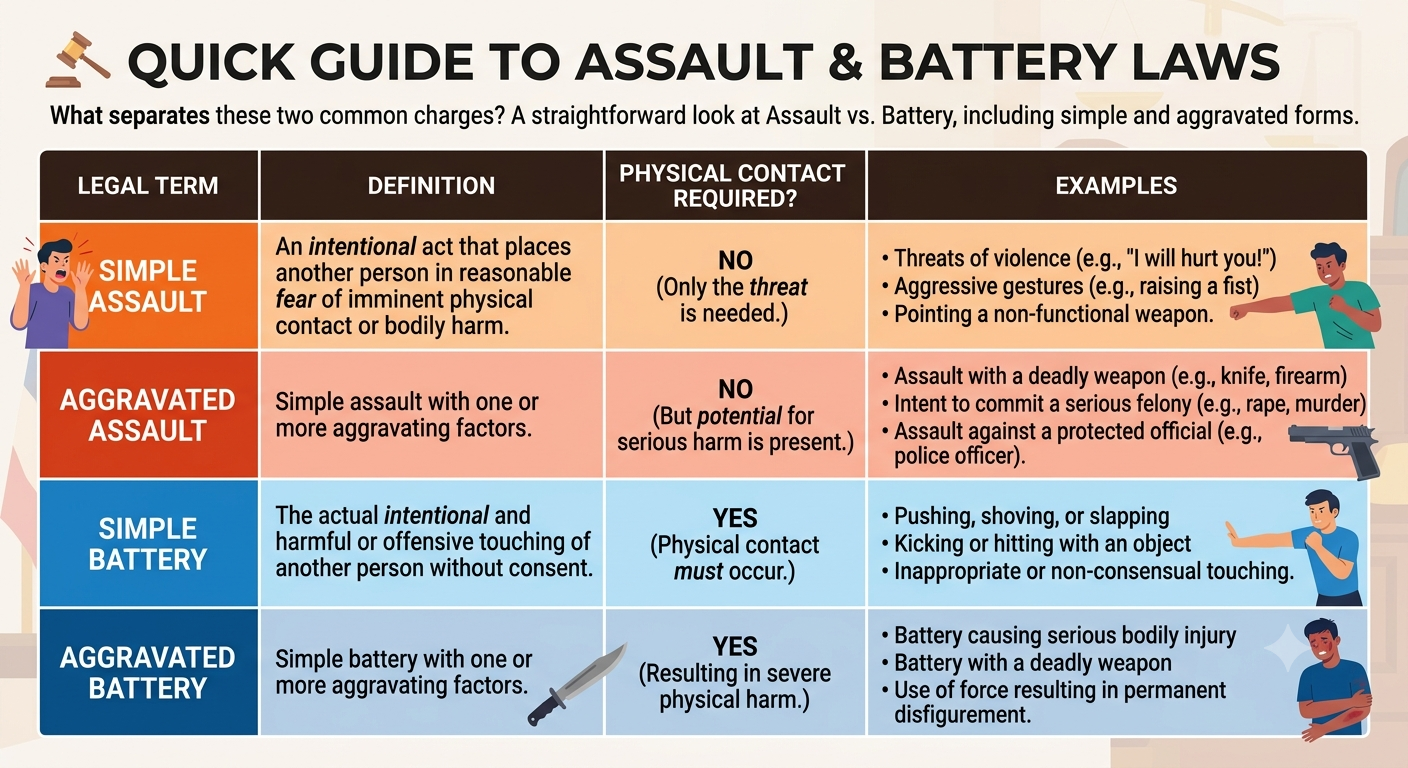
For a lot of folks who will say “assault and battery” as though they are the exact same offense, it’s not all that hard to figure out what we are all talking about when we talk about this type of offense.. However, understanding the difference between assault and battery is important because these terms represent separate offenses under the law, even though they are frequently connected and may occur during the same incident.
What the assault and battery charge is While often the terms “assault” and “battery” are used interchangeably in conversations to mean any physical aggressive act or fight, the definitions for an assault and a battery in the law is much narrower.. Knowing the difference between assault and battery can help individuals better understand news reports,legal documents, court proceedings, personal injury claims, and criminal charges where these terms are mentioned.
By learning the difference between assault and battery, people can avoid common misunderstandings and gain a clearer view of how these legal concepts apply in real-world situations.
For most people, assault occurs when there is a threatening touch and battery involves actual harmful contact.
But the precise legal definition, and the penalties, vary from one jurisdiction to the next. The following article explores the difference between assault and battery and how both crimes are generally defined and applies to real-world circumstances.
What Is Assault?
Assault is generally defined as an intentional act that causes a reasonable expectation or fear of imminent, unwanted, and unlawful touching. It is important to note that assault does not necessarily require physical contact to take place.
The most crucial aspect of assault is the expectation or fear of being touched. One can be accused of assault even if they do not touch another person if their actions cause the victim to expect or fear immediate touching.
An example of this is when a person raises their fist and moves towards another person with the apparent intention of punching them. This can be considered assault even if the fist never makes contact with the victim’s body.
Several aspects are necessary for a situation to be classified as assault. These include:
- Intent of the assailant
- An act or attempt to touch the victim
- A reasonable expectation or fear of being touched by the victim
- The difference between assault and battery is that the latter involves actual touching.
What Is Battery?
Battery generally refers to intentional and unwanted physical contact with another person. Unlike assault, battery typically requires some form of physical interaction.
The contact does not always need to cause serious injury. Depending on the law involved, even minor unwanted touching may qualify as battery if it is intentional and considered offensive or harmful.
Examples may include:
- Hitting another person
- Pushing someone intentionally
- Throwing an object that makes contact
- Unwanted physical contact during a confrontation
The seriousness of battery can depend on several factors, including the level of harm, the circumstances, and whether aggravating factors exist.
Assault vs Battery: Understanding the Main Difference
The simplest way to understand the difference between assault and battery is to focus on the presence of physical contact.
| Legal Term | General Meaning | Does Physical Contact Occur? | Example |
| Assault | Creating fear or expectation of immediate harm | Usually no | Threatening to strike someone while moving toward them |
| Battery | Intentional unwanted physical contact | Yes | Punching, pushing, or physically harming someone |
While these definitions provide a general explanation, legal interpretations can differ depending on the state, country, and specific circumstances.
Why People Confuse Assault and Battery
People often struggle to understand the difference between assault and battery because these terms are commonly mentioned together as “assault and battery.” The similarity of the two is the source of most of the confusion, since many times the language used would suggest that they actually refer to the same kind of crime when, legally, that is not the case.
Historically, many jurisdictions viewed both assault and battery as two separate but clearly connected offenses. In the entertainment and news media, “assault” was routinely used in many media as the generic word to refer to almost any kind of physical attack or violent crime.Understanding the difference between assault and battery helps clarify how each offense is defined under the law.
Real-life assaults and batteries are defined by legal factors instead of a lay person’s terminology.
For instance, you might get into trouble with the law in the area of assault but not battery; you might threaten a person with a quick and immediate physical response but never follow through with making physical contact. It is also quite possible to be found guilty of assault and battery without ever even verbally threatening the victim.
Examples That Explain the Difference
Understanding the examples will help to differentiate the concepts more easily.
Example of Assault
One person is approaching another one from behind and is about to hit him. The victim realizes that the person is going to hit him, but the latter one stops.
This example may be considered assault because there was an intention to harm the victim.
Example of Battery
One person is pushing another one during an argument. This action may lead to battery charges even though the victim was not seriously hurt.
Example Involving Both Assault and Battery
Sometimes one crime may involve both battery and assault. For instance, one person is threatening to hit another one and is hitting him after that. In this example, a threat is an assault and a pushing action is battery.
Why Understanding the Difference Matters
Knowing the distinction between assault and battery can play a role in various contexts: How an incident is reported. How legal claims are judged.
How cases are analyzed by courts.
For people caught in a dispute, an understanding can ensure accuracy of description. For law students and onlookers of a trial, it ensures a better comprehension of what offenses constitute what offenses. However, because the law differs significantly between different jurisdictions, anyone with an accusation of the sort or currently in dispute must seek out a capable legal advisor who knows the laws they practice under.
Types of Assault and Battery and Their Legal Implications
Interpretation of assault and battery can become easier by reviewing their possible categories. They can have different levels that depend on a number of circumstances related to the crime. Moreover, although various states may formulate the definitions differently, the overall categorization probably will be similar since it is supposed to be based on intent or the degree of force used
Common Types of Assault
Assault may have various forms depending on the circumstances and the degree of the threat.
Simple Assault
This form of assault is usually characterized by the fact that it does not lead to serious harm or injuries but involves a threat or attempt to cause it. This is why it is often referred to as an act, which creates a reasonable fear of imminent injury or damage. It does not require actual physical contact or injury.
Aggravated Assault
In contrast to simple assault, this type of attack is considerably more serious. Aggravated assault is a crime, which includes additional factors such as weapon use or serious injury as a result of the attack. Moreover, the determination of this crime depends on the jurisdiction and particular circumstances of the case.
Verbal Threats and Fear of Harm
In addition to simple assault, verbal threats that involve immediate harm or injury can also be considered assault. However, they are not regarded as a battery, which is an intentional and unlawful touching of another person with force. One of the major differences between assault and battery is that the first one implies the fear of imminent injury or damage while battery involves actual injury or damage.
Common Types of Battery
Battery generally requires some form of intentional physical contact, but the degree of severity may vary.
Simple Battery
Simple battery typically refers to an intentional, unwanted physical touching that does not cause significant harm. It may involve acts such as pushing, grabbing, or striking.
Aggravated Battery
Aggravated battery usually takes place when the act of assault causes severe injury, is committed in an especially cruel manner, or occurs to protected categories of individuals. Moreover, the punishment for aggravated battery is usually much more severe because the consequences are more damaging.
Criminal Cases And Civil Claims
The third way in which assault differs from battery is that criminal cases are brought by the state, while civil suits are filed by private citizens.
Criminal proceedings arise when a person is accused of committing a crime. A conviction results in the punishment, including fines or probation. Meanwhile, a civil suit seeks monetary damages to compensate for the harm caused to the plaintiff. Therefore, even if the same intentional act has occurred, it may result in two separate cases since criminal charges target the wrongdoer directly and civil litigation addresses the victim’s compensation claim.
Common Misconceptions About Assault and Battery
It is frequently mistakenly thought that assault is always violent in nature. Many legal authorities define assault to be where there is an intentional threat causing a person to feel that he or she is going to be hurt instantly, even without physical contact. The belief is common that battery will cause harm in some amount to be considered an attack.
In many jurisdictions it is thought not that battery includes the threat of contact even without injury.
It can be widely thought the law, to be uniform, can consider assault and battery to mean the same, but, as previously mentioned, each state may vary their approach to a claim involving assault and battery.
Why Legal Context Matters
Assault versus battery may vary with fact and circumstance. A judge or jury could look at intent, relationship between the parties, setting and a myriad of other factors to see if the action was done intentionally or accidentally. Physical contact while navigating a crowded room may not have the same legal ramifications as being deliberately physically attacked in the middle of a bar fight. However, general information is not the same as a specific consultation; individuals in need of legal action should contact their attorney in their specific area of the country or state to learn how the law might apply.
Conclusion
What Everyone Should Know About Assault and Battery Essay
Understanding the difference between assault and battery is essential because these two legal terms are often confused, even though they describe separate offenses with different meanings and consequences. Generally speaking, assault means to cause another person to believe that they are in immediate danger of bodily harm. Whereas battery implies that harmful or offensive contact was made with the other person. Knowing the differences will allow individuals to understand their rights and obligations as well as the implications of such charges.
The difference between assault and battery can also influence how a case is evaluated, as legal consequences may depend on factors such as the location, circumstances of the incident, severity of the actions, and applicable laws. Although these offenses are commonly mentioned together, each one has unique elements that must be taken into account when determining responsibility or punishment.
Learning the difference between assault and battery allows people to better understand legal terminology and avoid common misunderstandings surrounding these charges. Each and every circumstance is unique as to why each legal result might take on a completely different course from any others depending on the factual information that is provided and that there are to consider. Whenever you do have an assault or battery issue, legal consultation with the right lawyer can make all the difference in knowing exactly what choices and the ramifications which you will require to carry out.
Frequently Asked Questions
1. Can assault be committed without physically touching another person?
In some cases, assault is considered to be committed without touching another person. According to the law, it is enough to create an apprehension of imminent harm.
2. Can battery be a minor offense?
Battery can be either a felony or a misdemeanor depending on the circumstances of the case.
3. Can a single act be considered both assault and battery?
In some cases, one act can be considered both assault and battery.
4. Are assault and battery defined and classified the same way in all jurisdictions?
No, since assault and battery are classified as crimes and torts, their definitions may vary from state to state. 5. Who should I contact if I am accused of assault or battery? If someone is accused of assault or battery, they should contact personal injury lawyers to ensure their rights are protected.